04 — Articles
Buying a High-End Outdoor Kitchen in Montréal: How to Choose a Supplier
Choosing an outdoor kitchen supplier in Montréal comes down to concrete checks: the RBQ licence and its subcategories, who actually performs the gas and electrical work, a showroom where you can handle the materials, a quote itemized line by line, and the manufacturer's documents handed over before you sign. Here is the checklist to apply to any supplier.
How do you confirm a supplier is actually licensed?
By checking the Régie du bâtiment du Québec's public register yourself. It is free, open to everyone, and takes two minutes: the Registre des détenteurs de licence, searchable by company name or licence number. A salesperson saying "yes, of course we're licensed" has told you nothing. The number can be verified.
What the register record actually shows
The RBQ describes each record's contents: company contact details, the Québec enterprise number, the RBQ licence number, licence categories and subcategories, the bonding association or company, any current claims or indemnities paid, any licence restriction for public works, and the list of qualified representatives on the licence with their fields of qualification. Two lines are worth the detour: the claims tell you whether other clients have already drawn on the bond, and the representatives tell you who actually carries the technical qualification.
The subcategories that matter here
A licence is not a general pass. It is divided into subcategories, each tied to a type of work. Here are the ones that touch an outdoor kitchen, with the RBQ's official French titles.
| Subcat. | Official RBQ title | What it covers on your project |
|---|---|---|
| 1.2 | Entrepreneur en petits bâtiments | General coordination of residential work |
| 1.3 | Entrepreneur en bâtiments de tout genre | General coordination, broader scope |
| 2.6 | Entrepreneur en pieux et fondations spéciales | Helical piles under a kitchen or pergola |
| 3.1 | Entrepreneur en structures de béton | Poured slab or footings |
| 4.1 | Entrepreneur en structures de maçonnerie | Stone or block enclosure |
| 6.1 | Entrepreneur en charpentes de bois | Deck, shelter, wood framing |
| 15.2 | Entrepreneur en systèmes de brûleurs au gaz naturel | Hooking up a grill or patio heater to natural gas |
| 15.5 | Entrepreneur en plomberie | Sink, supply, drainage |
| 15.6 | Entrepreneur en propane | Propane-fed installation |
| 16.0 | Entrepreneur en électricité | Circuits, outdoor receptacles, lighting |
Nobody holds all of that under one roof, and that is not a criticism. The right question is not "do you have every subcategory?" but "which ones do you hold, and who do you hand the rest to?"
Who does the gas, and who does the electrical?
This question sorts suppliers faster than any other. A built-in natural gas grill, a fixed patio heater, an outdoor receptacle under an island: these are reserved works, and whoever performs them must hold the right licence — not the supplier selling you the cabinetry.
Electrical: the CMEQ and subcategory 16
The Corporation des maîtres électriciens du Québec issues the subcategory 16 contractor licence, the one that allows electrical work to be performed in Québec, and Québec's master electricians are mandatorily members of the Corporation. Search the company yourself in its directory, Trouver un entrepreneur. The CMEQ also publishes its convictions for illegal practice: the fines listed there reach $15,000, against businesses that performed electrical work without being members.
Gas and plumbing: the CMMTQ
Created in 1949 by the Loi sur les maîtres mécaniciens en tuyauterie, the CMMTQ brings together more than 2,800 specialized contractors in building mechanics, mainly plumbing and heating. For those contractors the licence is issued by the Corporation, and membership is required to obtain it; the member directory lets you verify it. Its list of penal convictions shows fines from $5,000 to $15,000 under section 20 of that same Act, notably for work performed without being a member in good standing.
Ask it plainly: "Is the gas yours or a subcontractor's? Name and licence number?" A serious supplier answers in thirty seconds. Subcontracting is not a flaw; opacity is.
Why does a showroom change the decision?
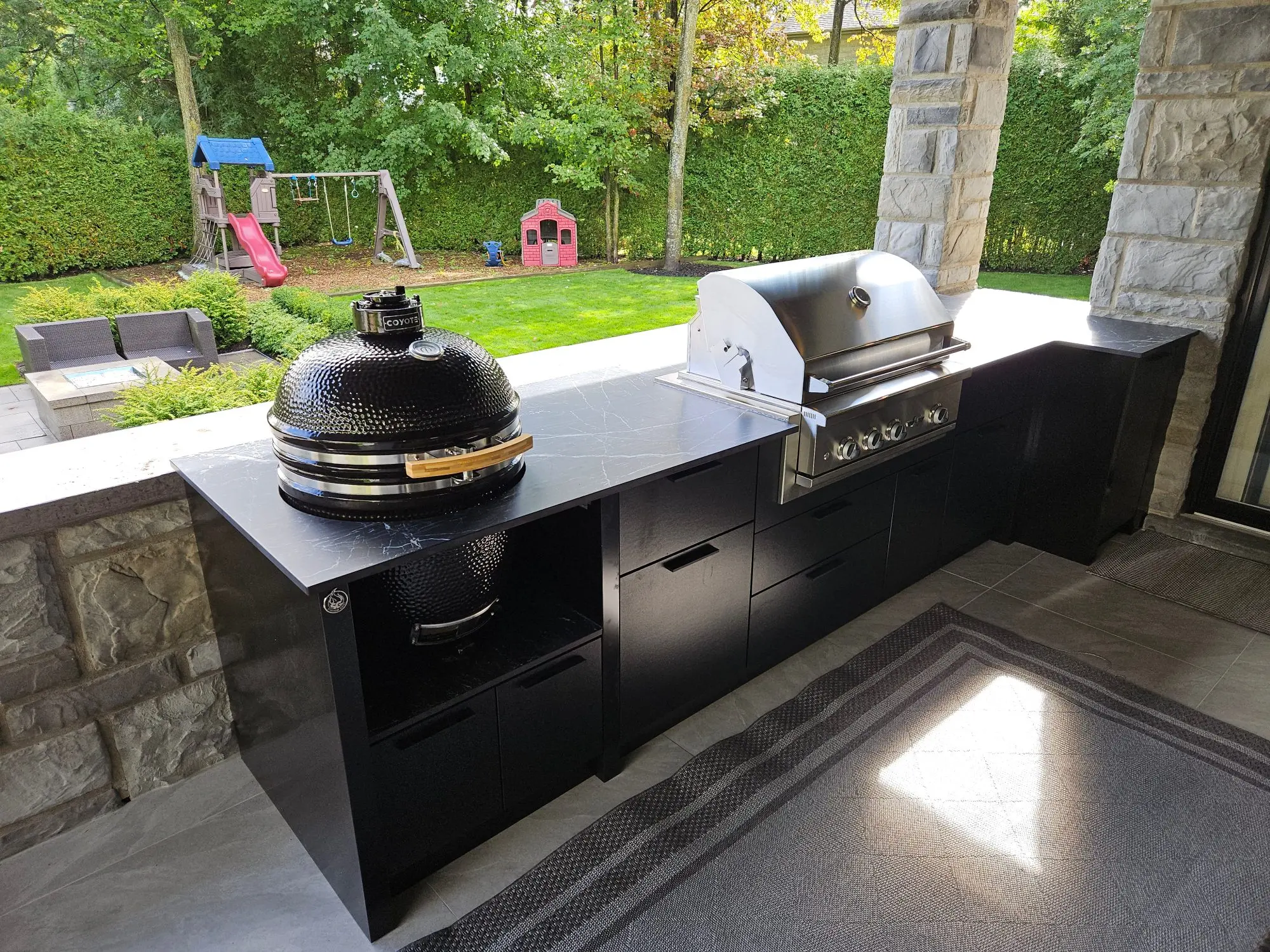
Because a photo tells you nothing about a material you will live with for fifteen winters: not the weight of a door, not the travel of a drawer slide, not the texture of a matte finish under your fingers. Ask to see an assembled module, not door samples. Open it, close it, look inside a cabinet box, find where water will collect.
Then ask about freeze-thaw: ask to see a cabinet box that has spent a winter outdoors, or to speak with a client whose project is three or four years old. Everything looks good the first summer. The fourth spring is what separates products.
How do you read an outdoor kitchen quote?
An honest quote is boring to read: long, and itemized. A quote that fits on one line with a lump sum is hiding decisions that belong to you.
Require that each of these appear separately, with a price or an explicit "not included": engineering and shop drawings, municipal permit, footings or piles, structure, cabinetry and countertops, cooking appliances, electrical, gas, plumbing, delivery, installation, site restoration. A "not included" in writing beats silence: at least you know the cost exists and that it will be yours. Be wary of "subject to site conditions" and "connections by others" — until they carry a number, the two quotes you are comparing are not comparable.
What documents should you demand before signing?
Before signing, not after. A supplier who promises documentation "once the order is placed" is asking you to sign blind.
| Document | What it tells you |
|---|---|
| Manufacturer's published snow load (pergola, shelter, roof) | Whether the structure is engineered for a Québec winter, and under what conditions |
| Manufacturer's warranty document | Actual term, exclusions, what is covered in parts and what in labour |
| Installation manual for the cooking appliance | Clearances to combustibles, ventilation, built-in requirements |
| RBQ licence numbers for the supplier and subcontractors | What you will go verify yourself in the register |
| Certificate of liability insurance | Who pays if something is damaged at your home during the work |
| Itemized quote and schedule | What you are buying, in what order, and what stays on your plate |
One point of honesty: if a salesperson quotes a performance figure — snow load, warranty term — that the manufacturer's own document does not confirm, the document wins. Ask for the page, not the sentence.
What authorized-dealer status actually changes
It changes access to original parts and to the manufacturer's service network, and it removes arguments about where the product came from when a claim is filed: an appliance bought outside the network and installed by a third party gives the manufacturer several reasons to refuse.
It changes nothing about the content of the warranty, which remains the manufacturer's, with its exclusions. Read the warranty document itself — that is what binds you, not the brochure.
And parts in five years?
Ask how long the brand has been distributed in Québec, who stocks the parts, and what the typical lead time is for a burner, a slide or a hinge. A supplier selling a product with no local service network is selling you a deferred problem.
Deposits, cancellation and the legal warranty in Québec
The deposit goes into a trust account
According to the Office de la protection du consommateur, section 254 of the Consumer Protection Act requires a merchant who collects a deposit before the contract is concluded to place it in a trust account at a Québec bank, caisse populaire or trust company; the money stays there until the contract is concluded or the consumer asks for it back. Some merchants are exempt, and the Office maintains the lists provided for in sections 254 and 256. It also notes that covered contracts must be written clearly in French, in two copies, signed first by the merchant.
Cancelling after fabrication starts
For contracts with no cancellation period set by a specific statute, the Office's page on cancelling a contract points to articles 2125 and 2129 of the Civil Code of Québec, which govern the resiliation of a contract of enterprise and what the client must then pay. Before putting a large deposit on custom work, get it in writing what happens if you cancel once fabrication has started.
The legal warranties no contract can remove
The Office lists the warranties that apply automatically and free of charge: the good must serve the use for which it is normally intended; it must work for a reasonable length of time, considering the price paid, the contract and the conditions of use; and it is protected against latent defects, meaning important defects present before the sale, undisclosed, and undetectable despite prudence. The good must also conform to the description made in the contract, in advertising and in the seller's representations.
The key point here: the Office states that you may proceed against the merchant, the manufacturer, or both, and that a merchant cannot force you to contact the manufacturer.
If something goes wrong
Write it down, date it, keep it. Describe the defect in writing with photos and dates, then send a formal demand letter with a reasonable deadline. If the supplier holds an RBQ licence, the register shows its bond, and a claim becomes possible on that side. With no licence, that recourse does not exist.
From the field
The question that settles the most files is the gas question. When a client asks us to compare three quotes, we start there. Two of the three almost always contain one vague line about the connection, and that line — not the cabinetry — is what explains the price gap.
We often see buyers compare a lump sum against an itemized quote and conclude the itemized one costs more. Nine times out of ten, it is simply complete. The test: add up what the short quote does not name, then compare again.
Where Mughet sits on this checklist
We apply the same checklist, and you are entitled to hold us to it. Service is offered in French and in English, and we keep two showrooms in the Greater Montréal area, one on the island and one on the South Shore, where modules are assembled: contact details and hours are on our contact page.
Our suppliers are public: Urban Bonfire, Station Grill, NatureKast, Outdoor Refinements Julien and Cubrics for kitchens and modules; Kamado Joe, Delta Heat, Twin Eagles, DCS Appliances and OFYR for cooking; Bromic and Heatsail for heating; Renson Pergolas; Phantom Screens and Wizard Screens & Shades for motorized screens; Northern Saunas; NewTechWood for cladding and decking; Solus Decor for fire features. Reserved works — gas, plumbing, electrical — are performed by licensed trades whose licence numbers we provide on request. Ask us for the documents in the list above: that is the point of the exercise.
Common questions
How do I check an RBQ licence myself?
Go to the RBQ's register of licence holders and search by company name or licence number. The record shows contact details, the Québec enterprise number, the licence number, categories and subcategories, the bond, any current claims or indemnities paid, any public-works restriction and the registered qualified representatives. It is free.
Does the supplier have to hold the gas licence itself?
Not necessarily. What matters is that natural gas or propane work is performed by a contractor holding the right subcategory: 15.2 for natural gas burner systems, 15.6 for propane. Plenty of suppliers subcontract this scope, which is fine. Ask for the subcontractor's name and licence number, then verify it in the register.
Can I deal with the manufacturer instead of the seller?
Yes. The Office de la protection du consommateur states that you may proceed against the merchant, the manufacturer, or both, and that a merchant cannot force you to contact the manufacturer. Describe the defect in writing, keep your photos and dates, and send a formal demand letter if the conversation goes nowhere.
Does the Garantie de construction résidentielle cover an outdoor kitchen?
The mandatory guarantee plan administered by GCR covers new residential buildings: detached, semi-detached or row single-family homes, duplex through quintuplex buildings, and divided co-ownership units, against design, construction or execution defects and soil defects. An outdoor kitchen added to an existing house is not on that list; your protection comes from the contract, the licence bond and the legal warranties.
Buying while knowing what you are buying
A high-end outdoor kitchen is not an appliance purchase: it is a small construction site, with structure, gas, electrical and materials that have to survive freeze-thaw. The difference between a good project and a bad one rarely comes down to the brand, but to what the supplier writes, itemizes and hands you before you sign.
To go further, our outdoor kitchen planning guide covers the technical sequence of a project, while our 8 outdoor kitchen tips and our piece on designing an outdoor BBQ kitchen deal with day-to-day use. On materials and products, see modular units for small spaces, Dekton surfaces, the marine-grade aluminum of Urban Bonfire, the wood finish of NatureKast and how to specify a Twin Eagles built-in grill. When your list of questions is ready, bring it: it makes for the best possible first meeting.