04 — Articles
NatureKast Outdoor Kitchen: the Farmhouse Wood Look That Lasts
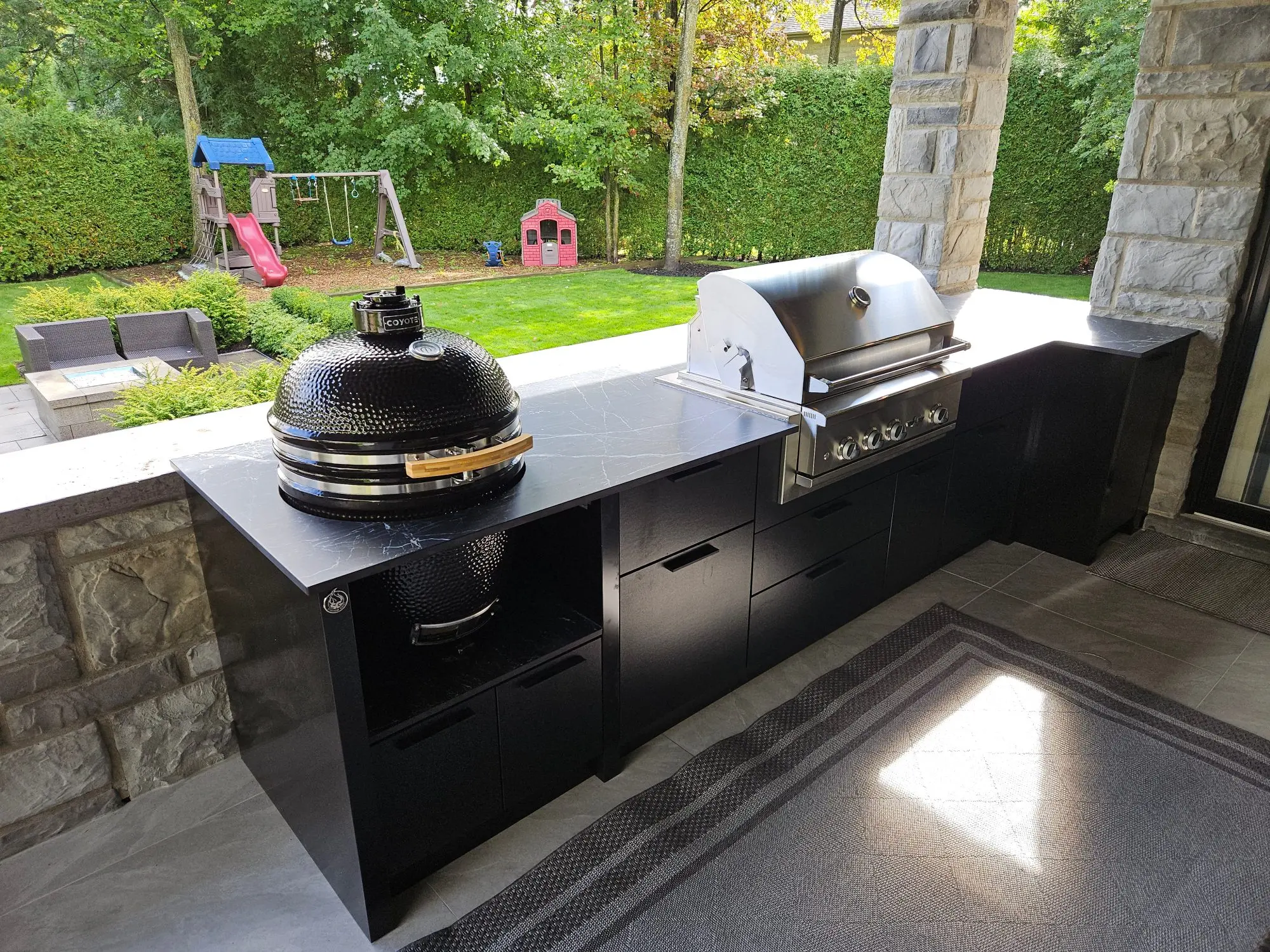
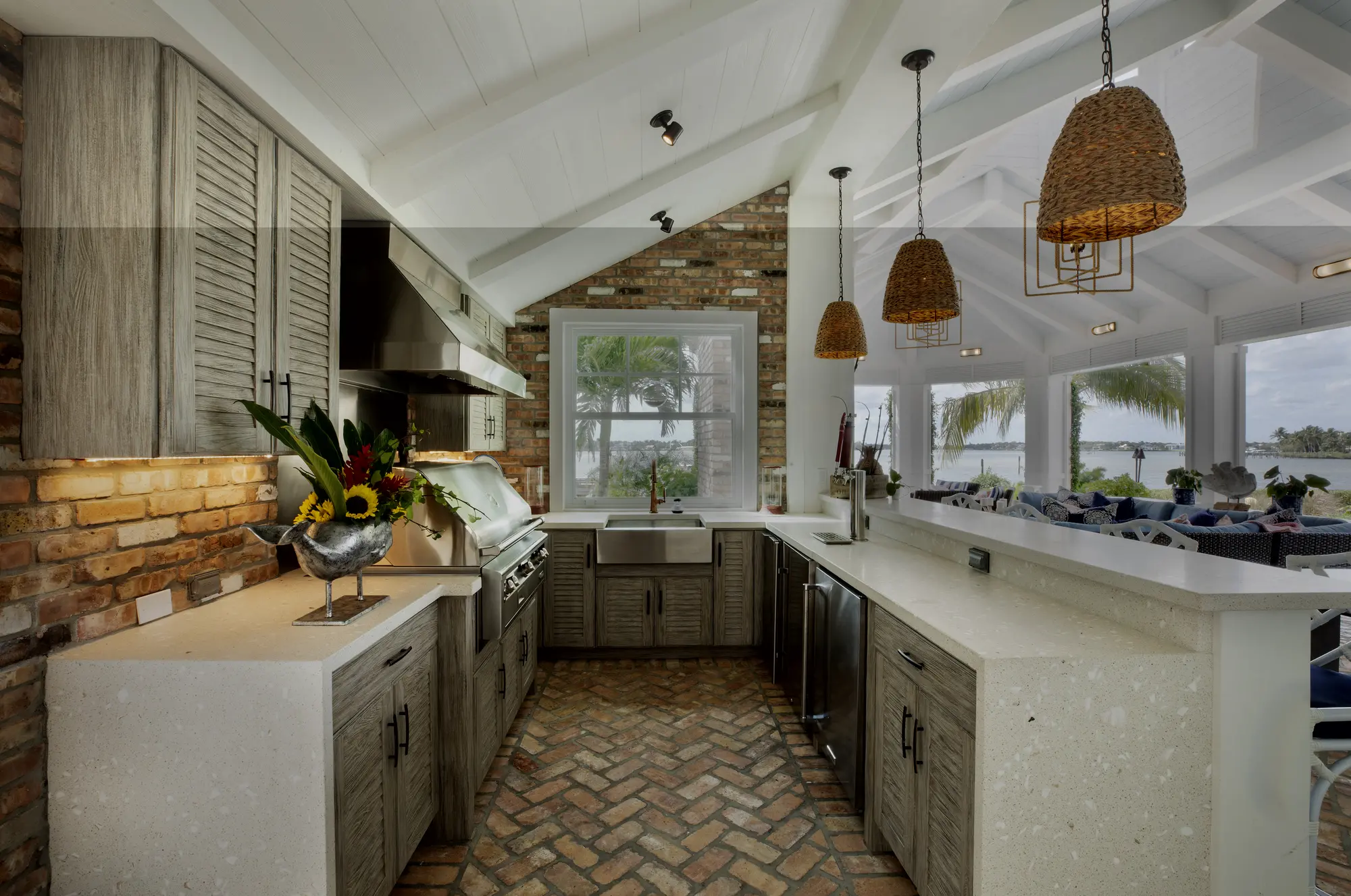
Yes, you can build an outdoor kitchen in Québec that still reads as warm wood, and the answer is polymer. NatureKast casts high-density resin doors in moulds taken from real cypress, mounted on closed-cell PVC boxes. You keep the farmhouse look outdoors, without the warping and rot of real wood.
What is a NatureKast cabinet actually made of?
"Polymer" on its own means nothing. There are four different materials in a single kitchen, and they do not behave the same way.
The box: closed-cell PVC
The box, sides, floors and tops are 3/4" 100% closed-cell PVC, assembled with a weld-like PVC cement bond plus screws, in white or black. This is not a finish. It is structure, and it has to be covered — that is where the real durability of the cabinet is won or lost.
The doors: resin, HPL or HDPE
The door depends on the collection. It sets the look, and it also sets what the warranty covers.
| Component | Material | Thickness | Look |
|---|---|---|---|
| Signature door (ResinKast) | Moulded high-density resin | 1" | Distressed cypress grain, stains and glazes |
| Euro door | High-pressure laminate, phenolic resin core | 1/2" | Wood décors and solid tones, polished ebony edge |
| Metro door | Marine-grade HDPE | 3/4" | Solid colours and wood grains, smooth edge |
| Cabinet box | 100% closed-cell PVC | 3/4" | White or black, meant to be covered |
| Drawer sides and back | PVC | 1/2" | 3/4" PVC drawer floor |
How is the wood look achieved, and how does it age?
Doors, drawer fronts and panels are created from moulds cast from real distressed cypress. This is not a print or an applied film: the relief is in the material itself, so the grain holds up to the hand and will not flake off an edge the way a veneer does. Colour comes after, through stain and glaze, under a UV-stable protective topcoat.
What the warranty says about fading
Here the marketing and the legal document tell two different stories. Several dealers advertise "wood that won't warp, fade or crack." NatureKast's own published limited lifetime warranty explicitly excludes bleaching and warping of the PVC and of the resin caused by direct sunlight or high heat, along with extremes of temperature and humidity.
The manufacturer's catalogue is blunter still: the PVC must be 100% covered by the doors and panels when placed in direct sunlight, specifically to protect it from warping under high temperatures and from colour bleaching. So the manufacturer itself acknowledges that its PVC moves and bleaches in the sun. That is not a hidden defect, it is a design rule.
The other clauses to read before signing
The "lifetime" coverage applies for as long as the original purchaser owns and lives in the home, residential use only, and it is not transferrable. The resin itself is covered for five years from the delivery date to the dealer. You must register within 60 days and submit claims in writing to the dealer. One good point: the warranty is not prorated.
How does it handle Québec freeze-thaw?
Closed-cell PVC does not take on water, so there is no water in the material to freeze. That is precisely what destroys a wood or plywood cabinet outdoors: water gets in, freezes, expands, and breaks the glue line cycle after cycle. PVC is chosen for outdoor kitchen structure in Québec for exactly this stability against frequent freeze-thaw cycles.
What polymer does not do is ignore thermal movement. A panel that goes from -25 °C in January to a scorching south-facing wall in July is working. Hence the specified assembly reveals: 1/8" at the top of the cabinet, 1/16" on each side, and zero at the bottom. An installer who closes those gaps to "tidy it up" gets caught by the first summer.
Doors, drawers and hardware: what holds up?
All hinge and drawer hardware is stainless steel. Concealed soft-close hinges at 110 degrees with six-way adjustment. Drawers ride on full-extension soft-close stainless steel side-mount slides.
Six-way adjustment is not a catalogue detail. On a terrace the slab moves, and doors go out of alignment by the second or third season. A hinge adjustable on three axes is squared up again in ten minutes.
What happens where a gas appliance meets a polymer cabinet?
This is the critical point of the whole file, and there is no approximation to accept here. Polymer is combustible. NatureKast states it plainly: because NatureKast cabinetry is combustible, an insulated grill jacket is required for built-in grills whenever the grill manufacturer specifies one.
The governing rule: CSA B149.1
In Canada, a gas appliance must be installed in accordance with the local code and CSA B149.1, the Natural Gas and Propane Installation Code — meaning per its certification and per the manufacturer's instructions, including its clearances to combustible construction. There is no universal number. The right clearance is the one in your appliance's manual.
For order of magnitude, here is what one built-in grill's installation manual requires. Above the countertop: at least 12" (305 mm) to the right, left and rear of a protected combustible wall, and 15" (375 mm) if it is unprotected. Below the countertop: 4" (100 mm) at the rear, 1" (25 mm) each side, and 3/8" (9.5 mm) to the front enclosure wall provided that wall is less than 1" thick. The same manual requires a non-combustible countertop surface. Another manufacturer will publish different figures. Yours governs.
The insulated jacket is not optional
The insulated jacket is what allows a gas grill to be built into a combustible enclosure. DCS is explicit: when building the grill into an outdoor enclosure made of combustible materials, use only the approved DCS insulated jacket, which has been specifically designed and tested for it. A generic or shop-made sheet-metal liner has not been tested with the appliance.
Design the clearance into the cabinetry
This requirement has a dimensional consequence that gets missed at the drawing stage. Per NatureKast, cut-out specifications for a zero-clearance insulation jacket can require the grill base to be anywhere from 6" to 12" wider than the grill itself. Add that grills normally need a minimum of 3" behind the appliance to open the lid against a wall, and that the majority of grills require a total depth of 27".
One last item, invisible but essential: ventilation screens are installed in the bottom of all grill base and burner base cabinets to prevent potential gas build-up inside the boxes. Never block them.
Which countertop suits this look?
The countertop has to be non-combustible where it carries the appliance, and it has to survive UV and frost.
| Material | UV resistance | Durability and upkeep |
|---|---|---|
| Ultra-compact (Dekton type) | Complete | Exceptional durability, very easy upkeep |
| Granite | Good, especially in dark tones | Very high durability, sealing required |
| Stainless steel | Complete | Very high durability, fingerprints to wipe |
| Concrete | Moderate, colouring tends to yellow in sun | Good durability, annual sealing |
| Engineered quartz | Poor | Strongly discouraged outdoors: resins yellow under UV |
Quartz is the classic trap: superb indoors, and it is the first material clients ask for. Outdoors the surface resin yellows. For a farmhouse project, dark granite or a matte ultra-compact give the mass the look needs without fighting the grain of the doors.
Which colour and finish work in Québec light?
The palette covers solid paints, wood-look stains and glazes, and weathered finishes, with custom colour matching available across all major paint manufacturers.
Our light is hard and highly reflective in winter: a sample that reads "warm" in a showroom will read greyer on a terrace in February. Always choose it outdoors, at the exact spot the kitchen will sit. And remember the natural-characteristics clause: variation in grain pattern, texture, colour and glazing is normal and is not covered. No two doors will ever be identical.
Routine cleaning
Mild soap and water, a soft cloth, no abrasive cleaners, no harsh chemicals, no steel wool. Denatured alcohol works on greasy spots on the PVC, and it is also what is recommended for the resin products. HDPE cleans with a mild detergent, and the Euro collection's HPL takes a citrus-based household cleaner if needed.
From the field
We lock the appliance model before ordering a single cabinet. The number of plans that reach us with a grill base drawn to the exact width of the appliance is remarkable. As soon as an insulated jacket is in play you need 6" to 12" more. A production lead time of roughly eight weeks is not the moment to discover you are eight inches short.
Exposed PVC is our number one inspection point. A run dying into a low wall, an island return, a south-facing counter overhang: anywhere a box is left bare to the sun, we add a matching panel. That is not aesthetics, it is what the manufacturer requires, and it is exactly the scenario the warranty refuses to cover.
We sell the ageing before delivery, not after. A door cast from cypress varies in grain and glaze from piece to piece. The client who has seen three doors side by side in the showroom is delighted on installation day. The one who was promised indoor-kitchen uniformity calls the next morning.
What are the honest limits versus aluminum?
Polymer wins on one front, but nobody else occupies it: a warm wood look with genuine relief, outdoors, with no wood maintenance. An aluminum cabinet or a stainless box will never do that convincingly.
On everything else, be honest. Aluminum — the Urban Bonfire approach, for instance — is non-combustible, which considerably simplifies the whole interface with a gas appliance. Polymer is combustible and imposes the discipline described above. Aluminum also carries no warranty clause excluding solar fading. And a stone countertop needs a properly engineered box and adequate support, not a panel spanning unsupported over a long run.
The right instinct is not to pick a camp but to pick per zone: many of our projects mix a stainless grill base with a wood-grain polymer storage run.
Common questions
Can I leave the kitchen outside all winter?
Yes, that is the whole point of the material: closed-cell PVC and resin do not absorb water, so nothing freezes inside it. What needs winterizing is the appliances and the plumbing, not the cabinetry. Protect the countertop from snow-clearing abrasion and keep the ventilation screens clear.
Is the warranty really lifetime on everything?
No. Coverage runs to the original purchaser, for as long as they own and live in the home, residential use only, and it is not transferrable. The resin is covered five years from delivery to the dealer. Bleaching and warping caused by direct sunlight or extreme heat are excluded, as is natural variation in grain and colour.
Do I absolutely need an insulated jacket?
If your grill manufacturer requires one for a combustible enclosure, yes, without debate: NatureKast cabinetry is combustible. Use the jacket approved and tested by that appliance manufacturer, not a generic equivalent. Some appliances do not call for one, others do. The answer is in your specific model's installation manual, alongside CSA B149.1.
Will the finish fade in the sun?
The topcoat is UV-stable and the doors are built for outdoor exposure. That said, the manufacturer excludes solar fading from its warranty and requires the cabinet PVC to be 100% covered by doors and panels in direct sunlight. In practice: the doors hold up well, but never leave bare PVC exposed to the south.
How long is the lead time?
NatureKast's stated standard production lead time is approximately eight weeks, varying with season, order volume and project complexity. In Québec that means ordering in winter or early spring. Add slab, electrical, gas and countertop time on top of that.
Using the material well
NatureKast is not a compromise on aluminum. It is a different material answering a demand aluminum cannot meet: warm wood that stays outside twelve months a year. It does that well on three conditions — never leave bare PVC in the sun, treat the gas interface according to the appliance manual and CSA B149.1, and buy knowing what the warranty excludes.
To place this choice in the wider project, start with our outdoor kitchen guide. Range details are on the NatureKast page, and our configurations under outdoor kitchens. For the appliance that will dictate your clearances, see our cooking appliances, the DCS page for insulated jacket requirements, and our article on Twin Eagles grills. For the decking around it, see NewTechWood composite. Our past projects show how it actually looks, and you can contact us to review a plan before ordering.