04 — Articles
Dekton Surfaces for an Outdoor Kitchen: What Actually Changes
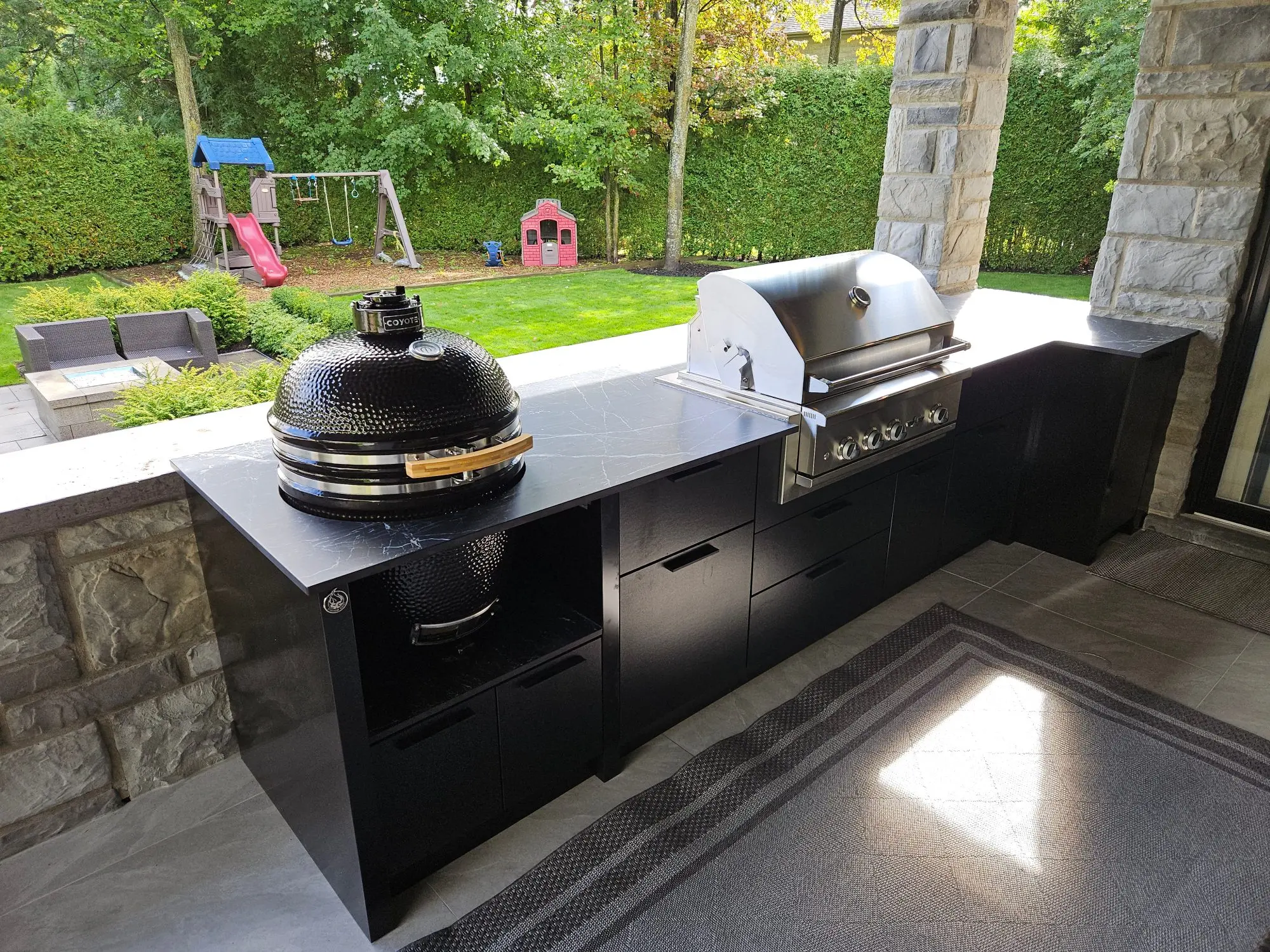
Dekton is an ultracompact sintered surface that absorbs almost no water, passes the standard freeze-thaw and thermal-shock tests, and never needs sealing. Outdoors in Québec, that changes three things: no seasonal countertop maintenance, no fading in the sun, no cracking after the first winter. In exchange, you accept a genuine vulnerability at the edges.
What is Dekton, exactly?
Dekton is an ultracompact surface made by Cosentino. It is neither natural stone nor resin-bound engineered quartz: it is a blend of minerals — glass, porcelain, quartz — pressed and then sintered at high temperature until porosity almost disappears. That absence of resin is why it behaves well outdoors. Organic binders are what yellow under UV and what swell when water freezes inside the material. A sintered product has none.
A family of products, not one number
Cosentino publishes its technical data by colour "family" (I through IV), and the values differ from one family to the next. When someone quotes Dekton's properties, they are quoting a range. Ask for the data sheet of the exact colour you are choosing.
Does Dekton actually survive a Québec winter?
Yes, and the reason is measurable rather than promotional. What destroys an outdoor surface in a cold climate is water entering the pores, freezing, expanding and cracking the material from the inside. With no pores, there is no mechanism.
Water absorption is the number that matters
Per the technical data sheets Cosentino publishes, Dekton shows 0.1% water absorption under EN ISO 10545-3, and 0.0% to 0.05% depending on the family under ASTM C373, which classifies it as impervious. Everything else follows from that.
Freeze-thaw and thermal shock: the actual tests
The EN ISO 10545-12 frost-resistance test is not a formality: specimens are vacuum-saturated with water, then run through a minimum of 100 cycles between +5 °C and −5 °C, held 15 minutes at each end. Dekton is reported as compliant, no damage. Same verdict on thermal shock under EN ISO 10545-9 and ASTM C484: no defects.
| Property | Test | Published result |
|---|---|---|
| Water absorption | EN ISO 10545-3 | 0.1% |
| Water absorption | ASTM C373 | 0.0 to 0.05% — impervious |
| Frost resistance | EN ISO 10545-12 | Compliant, no damage |
| Thermal shock | EN ISO 10545-9 / ASTM C484 | Compliant, no defects |
| Flexural strength | EN ISO 10545-4 | 50 to 54 N/mm² |
| Deep abrasion | EN ISO 10545-6 | 106 to 125 mm³ worn volume |
| Stain resistance | EN ISO 10545-14 | Class 5 (highest) |
| Chemical resistance | EN ISO 10545-13 | Type A — no damage |
| Thermal expansion | EN ISO 10545-8 | 5.1 to 6.5 × 10⁻⁶ °C⁻¹ |
| Hardness | Mohs scale | 7 out of 10 (Cosentino product guide) |
Will the sun fade my countertop?
Cosentino's product guide states that Dekton "is highly resistant to UV light and will not fade." We could not find, in the manufacturer's public documentation, the standardized colour-stability test that would put a number on that claim — unlike frost and thermal shock, where the standard numbers are printed in black and white.
What makes it credible is the warranty: the 25-year residential warranty document explicitly lists fading due to direct UV exposure, indoors and outdoors, among the things it covers. A manufacturer willing to pay out for 25 years is more convincing than a marketing page.
What thickness, and how far can it overhang?
Dekton comes in 4, 8, 12, 20 and 30 mm; for an outdoor worktop the conversation is about 12 and 20 mm. Nominal slab size is 3,200 × 1,440 mm at ±2%, which often allows a seamless countertop. The limits below come from Cosentino's "Countertops design & installation" document. They are not suggestions: exceeding them puts you outside the warranty, which excludes non-compliant fabrication and installation.
| Constraint | Dekton 12 mm | Dekton 20 mm |
|---|---|---|
| Overhang on one side | ≤ 300 mm (12 in) | ≤ 600 mm (24 in) |
| L-shaped overhang | ≤ 250 mm (10 in) | ≤ 500 mm (20 in) |
| Free span between supports | ≤ 1,000 mm (39 in) | ≤ 2,000 mm (79 in) |
| Spacing of support points | ≤ 900 mm (35 in) | ≤ 1,200 mm (48 in) |
| Cut-out to edge distance | ≥ 150 mm (6 in) | ≥ 100 mm (4 in) |
A 24-inch bar overhang is therefore achievable in 20 mm without additional support, but not in 12 mm. And a metal support must be at least 100 mm (4 in) wide: a thin angle biting 25 mm does not count as a support.
The slab has to sit on the whole cabinet
Cosentino requires the worktop to rest completely on the cabinet structure, not just around its perimeter. That drives the choice of modules: a marine-grade aluminum or polymer carcass with continuous rails meets the criterion; an open frame does not.
Edges, cut-outs and clearances
Recommended profiles in 12 and 20 mm run from square edge through quarter-round, half-round, bullnose, knife edge, dovetail and mitred apron. That last one — two pieces bonded at 45° to simulate 3 or 6 cm of thickness — is the most requested and the most demanding: Cosentino specifies a Mastidek-type adhesive or knife-grade epoxy for the joint. Internal cut-out corners need a radius of at least 10 mm (3/8 in) for a sink or cooktop, since a sharp corner is a crack initiator. Perimeter clearance against a wall must be at least 3 mm (1/8 in), and silicone around a cooktop must be high-temperature.
Who can cut Dekton, and how long does it take?
Not your carpenter. Cosentino's fabrication guide mandates water at all times — no dry cutting — and gives precise parameters: a 12-inch blade at 2,400 rpm, 14-inch at 2,200 rpm, 16-inch at 2,000 rpm, 1/8-inch depth per pass, plunge at 5 in/min. Feed rate drops to 20 in/min for white colours against 40 to 45 in/min for the rest.
For a built-in grill cut-out, you drill the four corners first, then remove the offcut — never plunge into a corner. So you need a bridge saw or waterjet and an operator who has handled sintered material before. The pool of competent shops is thinner than for granite, and that is what stretches lead times, not slab availability.
Cleaning: what works and what damages it?
Water and neutral soap day to day, and no sealer to redo — that is the real difference in use compared with outdoor granite. Dekton is rated Type A (no damage) for chemical resistance under EN ISO 10545-13, including cleaning products and bleach, and Class 5, the highest, for stain resistance under EN ISO 10545-14.
Two prohibitions named explicitly in Cosentino's technical manual: hydrofluoric acid, which attacks anything containing silica, and metal scouring pads. Hydrofluoric acid turns up in some rust removers — a real risk on a patio, not a theoretical precaution.
From the field
Templating happens after the modules are installed, never off a drawing. We have seen too many grill cut-outs ordered from an appliance spec sheet, with a delivered unit that did not match the drawing. On granite you rework it; on sintered stone you buy another slab. Our sequence never changes: modules set and level, appliances on site, physical template, then cut.
Edges are the only place this material worries us. An outside corner at hip height, in a tight passage between the island and a patio door, is going to get hit. We put a quarter-round there rather than a sharp square edge, and we shift the island a few inches if the clearance is tight. It costs less than replacing a section.
Cabinet flatness is not negotiable. On a wood deck that moves season to season, getting the carcasses perfectly level is real shimming work. We rework the supports before setting the slab even when the gap looks trivial: an ultracompact surface does not flex to accommodate a twisted cabinet, it cracks.
What the warranty actually covers
This is where the economics of the material sit, far more than in any promise of resale value. An outdoor surface that fails costs you the demolition, the appliances usually damaged in the process, and a season without a kitchen. The useful question is not "what does it return" but "what will the manufacturer pay for if it breaks".
25 years, transferable, must be registered
Dekton's limited residential warranty runs 25 years from the date of purchase, and it is transferable to the next owner. It does, however, require registration within 6 months of purchase — the most commonly forgotten formality, and enough on its own to void coverage. Have your supplier do it and keep the confirmation. Two other boundaries: commercial use is not covered, and the Grip and Grip+ slip-resistant finishes are covered for 5 years instead of 25.
Covered, and not covered
Covered: fading due to direct UV sunlight, indoors and outdoors, and cracking due to exposure to extreme hot and cold temperatures or thermal shock. In other words, precisely the two risks an outdoor countertop faces here.
Not covered: chipping, which the document describes bluntly as the result of scraping and bumping objects against the edges rather than a material defect. Also excluded are cracks and chips from the impact of heavy objects, seam appearance and performance, and any faulty or improper fabrication or installation. The manufacturer protects you against the climate; not against a dropped cast-iron pan or an improvised fabrication shop.
The honest limits
The best-documented one is impact. In 2015, Consumer Reports tested Dekton using the same protocol as 13 other countertop materials — a heavy object dropped from up to two feet. The 2 cm samples cracked clean through, with chipping at the edges; none of the other 13 cracked that way. Cosentino disputed the finding, saying the test conditions did not comply with its own installation guidelines, and Consumer Reports stood by its results. A public, unresolved disagreement, and one worth knowing before you buy.
Repairability comes next. A chipped edge on sintered stone cannot be sanded and re-coloured the way quartz can: you fill it, and the repair shows. That means designing to avoid the impact — rounded profiles, adequate clearances, no sharp corner in a traffic path — rather than counting on the fix.
Cost is last, and we will not publish a per-square-foot range: the dominant variable is not the slab but the fabrication, which depends on the number of cut-outs, the mitres, the simulated thickness and site access. Two projects of the same area can differ by a factor of two.
Common questions
Do I need to cover or remove the countertop in winter?
No. The slab does not need protection from frost — that is exactly what EN ISO 10545-12 and ASTM C1026 are about. A cover is still useful to keep the surface clean and save you from scraping in spring. Protect the plumbing, the appliances and anything holding standing water instead; those actually freeze.
Can I set a hot pan directly on it?
The material passes the standard thermal-shock tests and the warranty covers cracking tied to extreme temperatures. In practice we still use a trivet: the risk is not the slab, it is the silicone joint at a cut-out and the module underneath. Nothing requires you to treat the countertop as a landing pad for the grill.
Do knives scratch Dekton?
It is rated 7 out of 10 on the Mohs scale in Cosentino's product guide, above most kitchen blades. Cutting directly on it will generally not score the surface, but it will ruin your knives, and a polished finish can hold metal marks from rubbing — which the warranty explicitly excludes. Use a board, same as anywhere.
Which thickness for an outdoor kitchen?
20 mm in the large majority of cases. It doubles the allowable spans over 12 mm — 600 mm of overhang against 300 mm — and tolerates a cut-out closer to the edge, 100 mm against 150 mm, which matters when a built-in grill already occupies half the run. 12 mm remains valid for a backsplash or a module facade.
How long before delivery?
We do not publish a fixed lead time: it depends on the colour, the shop and the season, and a colour on backorder can add weeks. The point to remember is that the clock starts after templating on installed modules, not at signature. Plan the surface into the build sequence, not at the end of the project.
So is it the right choice for your outdoor kitchen?
If your criterion is not touching the countertop for twenty years, Dekton is one of the few materials that keeps that promise with standardized testing behind it. It needs no sealer, it does not fade, it survives freeze-thaw cycling, and the manufacturer puts a transferable 25-year warranty on exactly those points. If your criterion is impact tolerance, it is the wrong material — the Consumer Reports dispute shows that honestly.
The rest is build sequence. Start with the outdoor kitchen planning guide, choose the carcass before the surface — Urban Bonfire modules or NatureKast depending on the look — then confirm the cut-outs against your cooking appliances. Our Station Grill kitchens ship with Dekton worktops as standard. Browse the configurations in outdoor kitchens and our past projects, keep the layout tips handy, take a look at NatureKast cabinetry, and send us your dimensions: we will tell you what thickness your configuration needs before we talk about colour.