04 — Articles
Dekton or Stainless Steel: Which Outdoor Countertop Wins?
For the countertop of a Québec outdoor kitchen, Dekton wins. It handles freeze-thaw, UV, red wine and grease better than stainless steel, and it does not dent. Stainless keeps two territories where nothing beats it: cabinets and appliance faces, and any work surface that will take impacts.
The verdict, dimension by dimension
Every row below picks a side. For the technical detail on Dekton alone — families, thicknesses, overhangs, shop fabrication — see our Dekton outdoor kitchen guide.
| Criterion | Dekton | Stainless steel | Winner |
|---|---|---|---|
| Thermal shock | "No defects" (ISO 10545-9, ASTM C484) | Immune, but conducts (14–17 W/m·K) | Tie |
| Freeze-thaw | Water absorption 0.03–0.05% (ASTM C373) | Non-porous, no issue | Tie |
| De-icing salt | Cannot corrode | 304 pits; 316 holds up better, but is not immune | Dekton |
| UV and colour | Fading covered for 25 years | Does not fade | Tie |
| Scratching | Mohs 7: a knife will not mark it | Scratches visibly in a brushed finish | Dekton |
| Impact | Edge chips, excluded from warranty | Dents without breaking | Stainless |
| Staining (grease, wine, citrus) | Class 5, the highest (ISO 10545-14) | Water marks and fingerprints show | Dekton |
| Repairability | A chip cannot be repaired invisibly | A scratch is re-grained with the finish | Stainless |
| Weight | Up to 53 kg/m² at 20 mm | Sheet on a substrate: far lighter | Stainless |
| Seams | Glued seam, visible for life | Welded and refinished: near invisible | Stainless |
| Upkeep | Soap and water | Regular rinsing in salt zones | Dekton |
Right beside the grill: which one takes the heat?
Both pass. Dekton is tested for thermal shock to ISO 10545-9 and ASTM C484 with a "no defects" result, and Cosentino specifically covers those cracks in its 25-year warranty. Stainless has no thermal failure mode at outdoor-kitchen temperatures at all. The difference is conduction: 304 conducts at 14–17 W/m·K, so a sheet next to a side burner heats across its full width, while Dekton stays lukewarm thirty centimetres away.
The second measurable gap is expansion. Dekton's published coefficient of thermal expansion (ISO 10545-8) tops out at 6.5 × 10⁻⁶ °C⁻¹, against 16–18 × 10⁻⁶ /K for 304. Stainless therefore moves more than twice as much between January and July — hence the oil-canning ripple that shows up in sun on poorly fastened sheet, and fasteners that have to be designed to slide.
The Québec winter: frost is not the problem, salt is
On frost alone, it is a tie. Dekton absorbs 0.03 to 0.05% water (ASTM C373) and passes ISO 10545-12 undamaged: there is not enough water in the material for frost to split it. Stainless is not porous at all.
304, 316 and the "marine grade" myth
304 contains roughly 17.5–20% chromium, 8–11% nickel, and no molybdenum. 316 adds 2 to 3% molybdenum, which according to the International Molybdenum Association "improves pitting and crevice corrosion resistance." IMOA recommends 316 whenever an installation is "within five to ten miles of a large salt-water body or exposed to deicing salts."
But the alloy is only half the answer. IMOA is specific: in salt exposure, "a molybdenum-containing stainless steel with a smooth surface finish is needed unless frequent cleaning is acceptable." The British Stainless Steel Association writes that the standard 240 brushed finish should never be used in marine settings, and targets a maximum surface roughness of Ra 0.5 micron. Almost every stainless outdoor kitchen on the market ships in a No. 4 brushed finish, which is rougher than that. "Marine grade" on a brochure gets you nothing on its own.
How much salt actually reaches your patio? IMOA has documented seasonal de-icing salt accumulations "up to 1.9 km (1.2 miles) from busy roadways," and lists Toronto among the snowbelt cities where exposure is very high. The Nickel Institute reports 304 railings corroded after a single winter in Pittsburgh — but also 316 poles at Jones Beach, never cleaned and well washed by rain, with no corrosion after 56 years, while sheltered pieces at Miami Beach had corroded within a year. What kills stainless is not rain, it is shelter: countertop undersides, cabinet interiors.
What pool water changes
Chlorinated water is a chloride solution, and splashes that dry down leave a concentrated residue. The BSSA is blunt: "chloride-containing solutions, including hydrochloric acid-based cleaning agents and hypochlorite bleaches can cause unacceptable surface staining and pitting." Three metres from a pool, 316 is the floor and fresh-water rinsing is routine, not optional. Dekton reacts to none of it.
UV, grease and red wine: which one ages better?
On UV it is a tie: Dekton is warranted 25 years against fading in direct sunlight, and stainless does not fade.
On staining Dekton wins clearly: class 5 — the highest — on the ISO 10545-14 stain test, and "not affected" to ASTM C650 for common household products. Red wine left overnight, rib grease, lemon juice: nothing penetrates, because there is no porosity to penetrate. Stainless does not stain chemically, but it marks — fingerprints, hard-water spots, baked-on grease halos. To the eye there is no difference, and the cleaning becomes a weekly job.
Scratches, dents and chips: two opposite ways to fail
Dekton is hard: Mohs 7, and a knife will not mark it. But hard means brittle, and its weak point is the edge. Cosentino's technical manual requires "for all pieces that have corners, to make radius of at least 5 mm," and warns that "the material can be very sharp, especially the broken pieces." The warranty explicitly excludes "chipping or cracks... due to impact from heavy objects."
Stainless is ductile: it does not break, it deforms. A cast-iron pan dropped from a metre leaves a permanent dent in sheet metal and a chip in a Dekton edge. The dent is ugly but structurally irrelevant; the chip exposes a sharp arris and is not covered.
Repairability: re-graining versus an edge chip
A scratch in brushed stainless is repaired in place. The BSSA describes the method: "align and blend the new 'scratch pattern' with the original finish," using nylon abrasive pads and then silicon carbide. A deep dent will not come out; an edge chip in Dekton will not be repaired invisibly. Dekton gives you ten unmarked years and then one irreversible accident; stainless degrades slowly but almost always recovers.
Weight, seams and fabrication
Dekton is heavy: a maximum of 21 kg/m² at 8 mm, 32 at 12 mm, 53 at 20 mm and 79 at 30 mm, per the technical manual. A 3.5 m² island in 20 mm is close to 185 kg of countertop. No issue on a concrete slab; on a wood or composite deck you have to check the structure and often double the joists under the bearing points. Stainless never raises that question — the argument that sometimes decides a renovation.
Seams reverse the result. A Dekton run longer than the slab format needs a glued seam, visible up close and permanent. A stainless run is butt-welded, ground and refinished until the joint is close to invisible. Past 3 m in one piece, the metal wins.
Surface temperature in full August sun
The honest answer: neither Cosentino nor the stainless producers publish solar absorptance or surface-temperature data for these products. We have no number, and we are not going to invent one. What we can say is that the dominant variable is colour, not material. Matte black Dekton and brushed stainless facing south at 2 p.m. are both uncomfortable to touch; pale Dekton stays usable. The fix here is not the material, it is shade — a pergola solves it for both.
Warranties: the exclusions matter more than the term
The Dekton residential warranty runs 25 years, is transferable, and must be activated within 60 days of installation — a detail many owners miss. It covers manufacturing defects, staining from common foods and household products, cracking from thermal shock, and UV fading. It excludes chipping from impact by heavy objects, cracks caused by external force or uneven cabinets, faulty installation, seams, edges, and outdoor commercial use. That list is a precise description of what actually happens to an outdoor countertop: an impact, a cabinet that moves with frost, a seam that disappoints.
On the stainless side there is no equivalent material warranty: you inherit the cabinet or appliance maker's warranty, which covers fabrication and not corrosion. Be sceptical of salt-spray hours quoted in sales material, too. ASTM B117 itself warns that "prediction of performance in natural environments has seldom been correlated with salt spray results."
On price we will publish no figure: thickness, seam count, edge detail and fastening move a Dekton countertop far enough to make any average misleading. The only cost gap we can cite to a source is internal to the steel — 316 typically runs 20 to 30% more than 304 because of the molybdenum. Beside a pool or a salted street, that is the best-value upcharge in the project.
From the field
The failure we actually see is the edge chip, not the crack. Across our Dekton projects, we have never had a slab split by frost or faded by sun. What we have had, twice, is a chipped corner: a propane tank set down too fast, and a furniture move. Out of warranty both times. That is why we impose a corner radius at the drawing stage.
Stainless is judged where the rain never reaches. Inspecting a five-year-old kitchen, we do not look at the top — the top is always fine. We look at the countertop underside, under the handles, and inside the doors on the street side. On brushed 304 in Montréal, brown pitting shows up there around year three or four when nobody rinses.
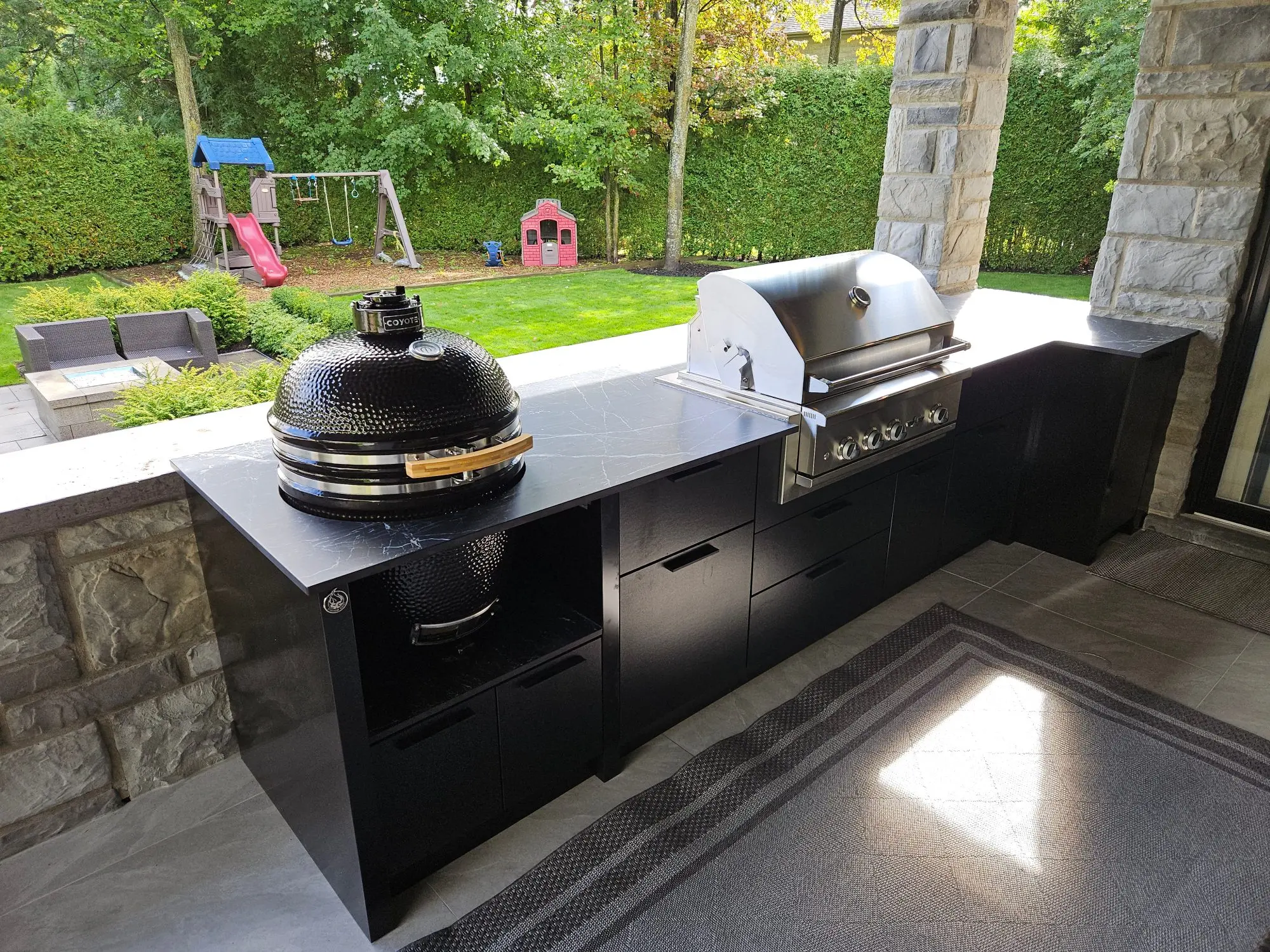
Our design reflex: Dekton horizontal, stainless vertical. Countertop and island top in Dekton; cabinets, drawers and appliance faces in stainless or marine-grade aluminum. This is not a diplomatic compromise — each material loses exactly where the other wins.
Pick based on your situation
Choose Dekton if…
Your countertop is a normal prep and serving surface; you want to cut on it, set a hot dish down, forget a glass of red wine and rinse it tomorrow; your patio gets de-icing salt or sits beside a pool. That describes the large majority of the residential projects we build.
Choose stainless steel if…
The surface is a heavy work zone where things get dropped; or the counter runs past 3 m in one piece with no visible seam; or the existing structure cannot carry a mineral slab; or you want the monolithic look only welded metal gives. In those cases specify 316 if the patio is salted, demand the smoothest finish the maker offers, and accept the rinsing.
Choose both if…
The most common case, and it is not a dodge: Dekton on the work surfaces, stainless on the structure and the cooking appliances. Placement is what makes it last.
Common questions
Can Dekton crack from frost in Québec?
No, and it is measured: water absorption is 0.03 to 0.05% to ASTM C373, which classes it impervious, and it passes the ISO 10545-12 frost test undamaged. Frost splits porous materials by expanding the water inside them; here there is almost no water to expand. Cracks that appear in winter come from a support that moves, not from the slab.
Is 316 really necessary in Québec, far from the sea?
Often yes — not because of the sea, because of road salt. IMOA recommends molybdenum wherever there is de-icing salt exposure, which it has documented up to 1.9 km from busy roadways. Near a salted street or a pool, 316 is justified; at the back of a large lot, well away from traffic, regularly rinsed 304 does the job.
Can you set a hot pan directly on Dekton?
The material passes ISO 10545-9 and ASTM C484 with no defects, and the warranty covers cracking from thermal shock. In practice we still recommend a trivet on edges and overhangs: the risk is not the surface, it is the local stress on an unsupported zone. On a fully supported area there is no issue.
Can a chip in Dekton be repaired?
Not invisibly. Tinted resin makes it acceptable from a distance, but it stays perceptible in raking light and to the touch. A badly damaged edge gets replaced, which adds a seam. That is the price of the material's hardness, and it is why the warranty specifically excludes impact chipping.
Does brushed stainless scratch much in real use?
Yes, it is a ductile metal. But the repair is routine: the BSSA describes aligning and blending the new scratch pattern with the direction of the original finish, using nylon abrasive pads then silicon carbide. A well-maintained ten-year-old stainless work surface shows an even patina rather than a collection of scratches.
What to take away
Dekton wins the countertop on every failure mode but one: impact. Stainless wins the structure, the appliance faces, long unbroken runs and any surface that will take knocks. Both survive a Québec winter — but stainless only if it is the right grade, the right finish, and rinsed.
The real design work is putting each material where it does not lose. See our outdoor kitchens, our outdoor kitchen guide and our layout tips. For cabinets built for our winters, read our piece on Urban Bonfire kitchens, and browse our past projects. Ready to decide on your actual plan? Write to us: a project manager will measure salt exposure, sun and your structure's capacity before recommending anything.