04 — Articles
Outdoor Kitchen: 8 Tips That Change How It Performs
An outdoor kitchen that actually performs through a Québec year comes down to eight decisions: where the prep counter sits, which way the smoke goes, how the counter is lit, drawers or doors, the stainless grade, how water leaves the surface, where the propane cylinder lives, and what you cover in October. None is expensive to fix on paper; all of them are once the countertop is set.
Where should the prep counter go relative to the grill?
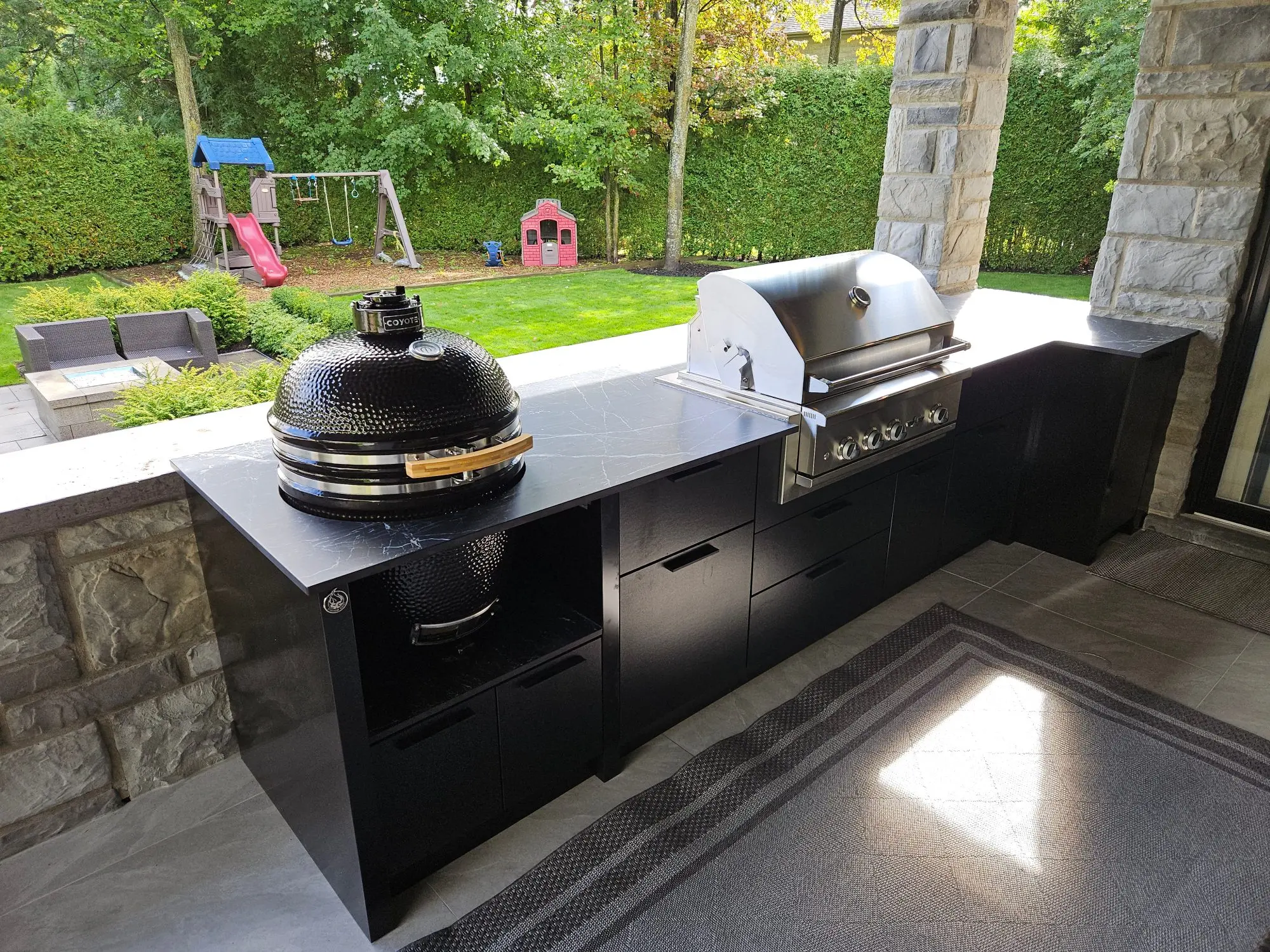
On both sides of the built-in grill, not one. That single choice separates a kitchen you cook in from a kitchen you look at. The National Kitchen & Bath Association (NKBA) planning guidelines call for landing area of at least 12 in. on one side of the cooking surface and 15 in. on the other. That minimum is thin: it is room for a hot pan, not for breaking down a chicken.
The wide side goes where you open the lid and stand. The NKBA also asks for 15 in. of landing at the refrigerator, and 24 in. on one side of the sink with 18 in. on the other. Add it up and a credible outdoor kitchen rarely starts under three linear metres.
Counter height is not one height
The NKBA recommends two work heights rather than one: 28 to 36 in., and 36 to 45 in. Outdoors that reads as a low prep counter and a raised bar. The raised bar also shields guests from grill heat and hides the working surface — the real reason people like it.
How do you orient the kitchen so smoke does not blow back at you?
The grill goes downwind of the seating and away from the openings of the house. Health Canada is explicit: use a barbecue "outside and in a well-ventilated area," "far away from combustible materials and windows and doors." The reason is not comfort, it is carbon monoxide.
A yard's prevailing wind is not read off a map, it is observed. Spend a season noting where the breeze comes from at 6 p.m., the hour you actually cook. The house, the fence and mature trees distort the regional pattern far more than people expect.
What sits overhead matters as much
The NKBA recommends 24 in. of clearance between the cooking surface and a protected noncombustible surface, and notes that code requires at least 30 in. above an unprotected combustible one. Under a pergola, the question becomes whether the louvre or fabric is combustible, and at what height. The answer comes from the appliance's certified instructions, not from a general rule.
What lighting do you actually need at the counter?
A ceiling fixture directly above a cook casts a shadow exactly where the knife is. It is the most common lighting mistake outdoors, and the easiest to avoid: task light comes from in front of or beside the work surface, never from behind the head.
The target levels are documented. The IESNA Lighting Handbook places kitchens and food preparation areas at 30 to 75 foot-candles, or 300 to 750 lux, and NKBA Guideline 31 asks that every work surface be well illuminated by appropriate task lighting. In practice: a strip under the raised bar overhang, plus separate ambient light on its own dimmer.
The electrical detail that fails an inspection
Rule 26-704 of the Canadian Electrical Code (2021) requires 15 A and 20 A receptacles within 2.5 m of finished grade to be protected by a Class A ground-fault circuit interrupter, which trips at 6 mA. Plan the circuits at design stage, not at hook-up.
Drawers or doors in a freeze-thaw climate?
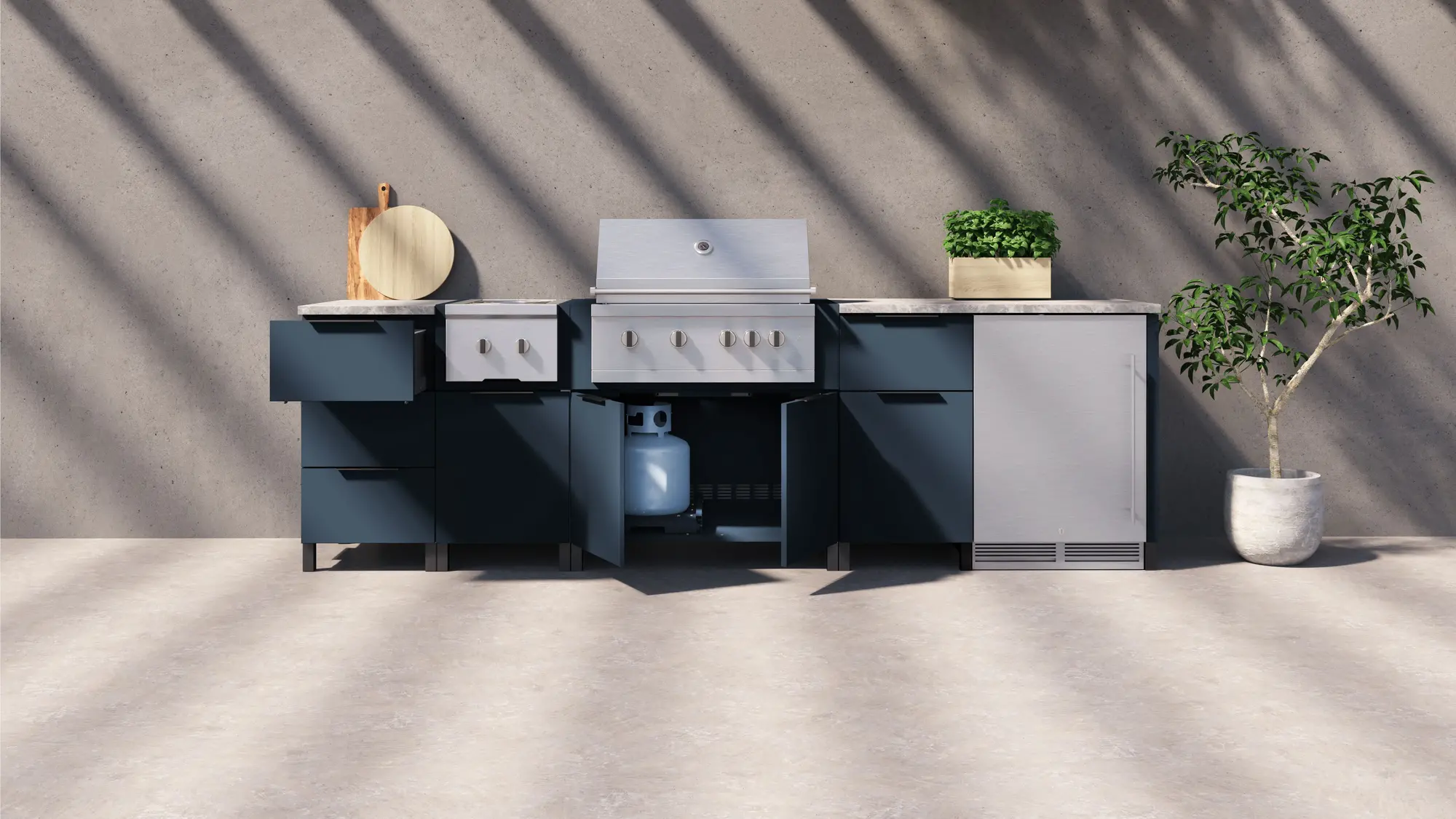
Drawers, almost always — for a reason that has nothing to do with ergonomics. A door opens onto a single uncompartmented volume where water that gets in stays in. A drawer comes out of the cabinet: what it holds is visible, empties and dries.
The cycle that wrecks an outdoor kitchen is well documented. Ouranos defines a freeze-thaw event as a day when air temperature crosses 0 °C within 24 hours, and reports that in southern Québec these events peak in October, November, April and May, at 5 to 25 days per month depending on the region (1981-2010). That is that many chances for water trapped in a hinge or a slide to expand.
What to demand of a cabinet, whatever the material: vents top and bottom, a perforated or sloped floor, stainless slides. A sealed cabinet is a trap; a cabinet that breathes dries out.
304 or 316 stainless: which one survives road salt?
The difference comes down to one element. Grade 316 contains molybdenum — a minimum of 2%, typically 2 to 3% — and 304 contains none. Molybdenum specifically improves resistance to chloride-driven pitting corrosion. The industry index, PREN, is written %Cr + 3.3 × %Mo + 16 × %N: remove the molybdenum and the number drops.
Two figures make this concrete here. The International Molybdenum Association rates 304/304L as the most cost-effective choice at low exposure and 316/316L once the risk becomes moderate — which is what proximity to salted roads produces. And calcium chloride, widely used in Québec because it works at low temperature, becomes corrosive at 0 °C and 45% relative humidity.
The British Stainless Steel Association adds the factor people forget: rain washing is an advantage. So the exposed face of your kitchen is not what rusts first — the underside of the counter and the back of the cabinet are.
| Criterion | 304 stainless | 316 stainless |
|---|---|---|
| Molybdenum | None | Min. 2% (typically 2-3%) |
| Typical base | 18% Cr / 8% Ni | Comparable Cr, Ni min. 10% |
| Chloride resistance | Prone to pitting | Markedly better |
| IMOA guidance | Low exposure | Moderate risk and above |
| Cleaning to keep appearance | 4+ times a year in moderately corrosive conditions | Less, if the grade is well chosen |
| Sheltered, unrinsed areas | Elevated risk | Elevated risk too |
The last row is the one no brochure leads with: IMOA treats the absence of rinsing as a risk factor in itself, whatever the grade. "Marine grade" does not exempt you from the bucket of warm water.
From the field
What we see most often on service calls is not surface rust, it is a drawer that will not close. The slide froze full of water and deformed, and the client concludes the cabinet was poor quality. Nine times out of ten the cabinet was fine — the countertop was draining inward instead of outward.
We ask where the salt goes before recommending a stainless grade. A kitchen at the back of a fenced yard does not take what a front terrace facing a brine-treated boulevard takes. The second case justifies 316; the first often does not.
And we push hard on one detail that looks like nothing: the cylinder has to be reachable without lying on the ground. A client who has to empty a cabinet to swap a tank ends up leaving it leaning against the island instead. That is where the safety problem starts, and it traces back to a design decision made two years earlier.
How do you stop water from sitting — and freezing?
Water must never have anywhere to stop. On adjacent hard surfaces the usual reference is a 2% slope, roughly 0.25 in. per foot, for impervious surfaces within 10 ft of the foundation. Apply the same logic to the countertop: a slight, consistent fall away from the house, and no back-pitch at the sink.
Porcelain, stone, concrete: what actually matters
Porcelain is defined by water absorption of 0.5% or less under ASTM C373, and its freeze-thaw resistance is verified by ASTM C1026: fifteen cycles, frozen at -18 °C out of water, thawed at 10-16 °C in water. The honest caveat comes from the industry itself — the Tile Council of North America calls "substantially incorrect" the widespread rule of thumb that tile above 3% absorption is unsuited to freeze-thaw. Ask for the test result, not the percentage.
Porous natural stone gets sealed, and resealed: sealer is not a lifetime treatment and it compensates for no slope defect. Run the test that does not lie — pour a glass of water in the middle of the counter. If a puddle stays, it will still be there in November.
The water line, before the first frost
The City of Montréal gives the procedure in one line: shut off the outdoor water supply, disconnect the hoses and drain the taps before the first frost. For an outdoor kitchen that means a dedicated interior shut-off valve and a drain point at the low point of the run. If your installer cannot show you both, the sink is not winterizable.
Where does the propane cylinder go to stay legal and reachable?
Outdoors, upright, ventilated, reachable in ten seconds. The Régie du bâtiment du Québec is direct: store cylinders "outdoors all year round," keep them "upright and protected from impacts," on a solid base, away from ignition sources and any exposure above 50 °C. A refillable cylinder is not kept inside a residential space. The Canadian Propane Association adds two deadlines: requalification every ten years — it is illegal to fill an outdated cylinder — and never fill beyond 80% of capacity.
Clearances are not a universal number
This is the point most articles miss. CSA B149.1 defers explicitly to the manufacturer: every appliance must be installed in accordance with the manufacturer's certified instructions (clause 4.1.1), and clearances to combustible material follow those same certified instructions (clause 4.13.1), with reductions permitted only using approved protection. So there is no "X inches behind the grill" that holds everywhere — the number is your appliance's. Keep the manual; it is part of the kitchen.
Beyond that, the leak test is the highest-value annual habit: a 50/50 solution of water and dish soap on the connections and hose, then look for bubbles.
Should you cover the kitchen for winter?
Cover the appliances, yes. Wrap the cabinetry, no. A fitted, breathable cover on the grill or the refrigerator protects them from airborne salt. A waterproof tarp stretched over a whole island does the opposite: it traps moisture, prevents drying between thaws, and turns those 5 to 25 freeze-thaw days a month into that many wet cycles.
The rule: anything with a motor or a burner gets covered; anything structural breathes and gets rinsed. And if the goal is to use the kitchen in November rather than wrap it in October, the real lever is elsewhere — a motorized screen that blocks wind, and a heat source sized for the space.
Common questions
Is 316 always necessary in Québec?
No, and selling it as mandatory would be dishonest. The criterion is chloride exposure, not the province. IMOA places 304 at low exposure and 316 once risk becomes moderate. A sheltered kitchen well away from a salted road and rinsed each spring does fine in 304; a terrace on a brine-treated street justifies 316.
Can an outdoor kitchen go under an enclosed pergola?
Not without checking two things. First, carbon monoxide: Health Canada requires a well-ventilated spot away from doors and windows. Second, the clearance above the appliance, which comes from the manufacturer's certified instructions under CSA B149.1 clause 4.13.1, not from a generic value. A louvred pergola left open while cooking generally settles the first point.
How often should exterior stainless be cleaned?
In moderately corrosive conditions, IMOA notes that 304 may need cleaning four or more times a year to keep its appearance. In Québec, a warm soapy rinse each spring, after the de-icing season, is the useful minimum. Concentrate on the areas rain never reaches.
What do you do with the propane cylinder in winter?
It stays outside. The RBQ requires outdoor storage year-round, upright, on a solid base, protected from impacts and heat sources — not the garage, not the basement. While you are there, check the date: past ten years no distributor will refill it.
What separates a kitchen that ages well
None of the eight tips above is about choosing an appliance. All of them are about the plan: where water falls, where light comes from, where smoke goes, what dries and what stays wet. An appliance is replaced in a day; a reversed slope in a stone countertop is corrected with a demolition hammer.
At the planning stage, have the orientation, clearances and drainage validated before choosing anything: our outdoor kitchens are configured around those constraints, and the cooking appliances come after, with their certified instructions in hand. To extend the season instead of wrapping the space, look at outdoor fireplaces and patio heaters and, indoors, the Noréa fireplace range; for surfaces that take the freeze-thaw, at wall siding and decking. A project manager can walk through your plan — write to us.