04 — Articles
Outdoor Fireplaces and Patio Heaters in Québec: Extending the Season
On a Québec patio, the day is never the problem. The evening is. In Environment and Climate Change Canada's normals for Montréal-Trudeau, only one month of the year has an average minimum temperature above 15 °C: July. In May it drops to 7.9 °C, and in September to 10.3 °C. An outdoor fireplace or a patio heater won't change the weather — it changes what time you go inside. Here's how to choose, where to install, and what Québec regulations actually allow.
Are wood-burning outdoor fireplaces allowed in Montréal?
No. Outdoor fires are prohibited across the Montréal agglomeration, garden fireplaces included, unless the fire department grants an exceptional authorization. The City does, however, place gas and electric appliances outside the solid-fuel category: those remain permitted, and domestic use of a certified patio heater requires no permit at all.
What the City bans, and what it lets through
The distinction comes down to one word: fuel. Montréal's solid-fuel appliance by-law targets wood, eco-logs, coal and pellets. A natural gas, propane or ethanol fireplace falls outside that definition. That's why almost every outdoor fireplace installed on the island in recent years runs on gas.
Montréal's fire department takes the same line on domestic appliances: a barbecue, a patio heater or a similar certified appliance can be used without a permit. An open fire or a garden fireplace, on the other hand, requires prior authorization.
What about off the island?
Every municipality writes its own by-law. Laval, Longueuil, Blainville, Terrebonne and Saint-Bruno don't apply the same rules, and some do allow wood-burning fireplaces with conditions on clearances, chimney height or hours of use. One call to your city's planning department before you buy will save you from a several-thousand-dollar purchase you can never legally use.
Outdoor fireplace or patio heater: which one actually warms you?
Both, but not the same people. An outdoor fireplace creates a gathering point: the heat is beautiful, concentrated, and gone the moment you step back three feet. An infrared patio heater warms people and surfaces rather than air, which keeps it effective even in a breeze. On an open patio, one supplies the atmosphere, the other supplies the comfort.
Why heating the air is pointless outdoors
Physics is stubborn. Warm air rises and dilutes within seconds into an infinite volume; the slightest breeze undoes the work. Infrared radiation passes through air without heating it and deposits its energy on whatever it strikes: your skin, the table, the concrete slab — which then radiate it back.
An ASHRAE Journal article (Roth, Dieckmann and Brodrick, June 2007) states the principle plainly: in environments exposed to large quantities of outdoor air, radiant infrared heaters do a better job of heating people than convection does. That is exactly the situation on a Québec patio in September.
What each appliance really does
| Appliance | What it heats | Real reach | Best use |
|---|---|---|---|
| Gas outdoor fireplace | Whoever is sitting in front of it | 1 to 2 m | Building an outdoor living room, an architectural focal point |
| Fire table | The circle around the table | 1 to 1.5 m | Stretching out drinks, replacing a campfire without the smoke |
| Infrared patio heater | A whole zone, from above | 6 to 15 m² per unit | Making the dining table usable in May and October |
In most of the projects we design, the right answer isn't "one or the other." It's a fireplace for the eye, and infrared above the space where people eat.
Which outdoor fireplace actually survives a Québec winter?
The one whose material takes freeze-thaw cycles without cracking, and whose steel doesn't rust from road salt. Three families hold up in our climate: high-performance fibre-reinforced concrete, 304 stainless steel, and the built-in fireplace clad in the same material as the house. Everything else ends up in spring repairs.
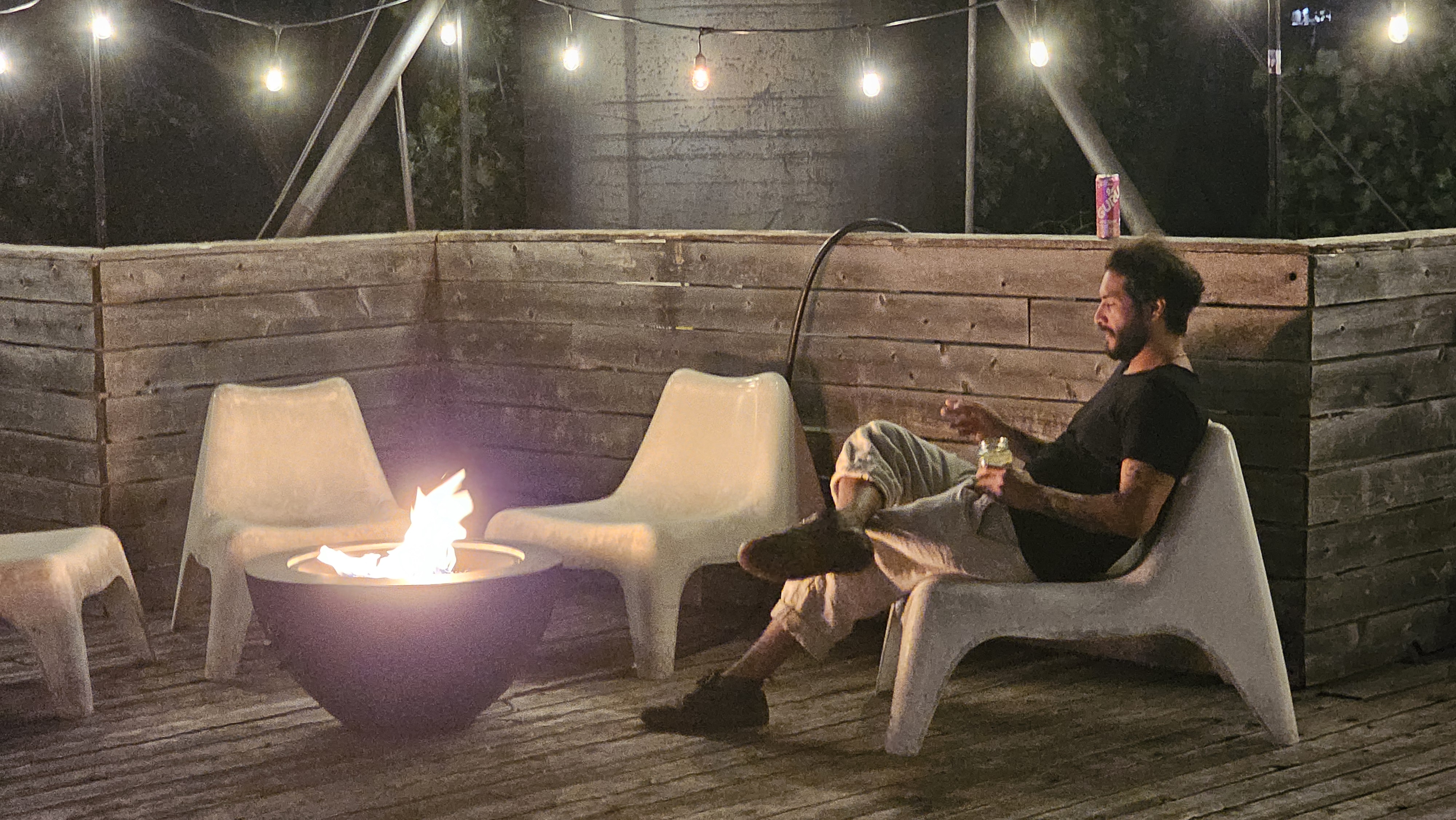
Fibre-reinforced concrete: Solus Decor
Solus Decor has designed and hand-cast its pieces in Vancouver since 1998. The material is a fibre-reinforced concrete tested to ASTM standards, with a rated strength of 60 MPa (10,000 psi) on the Hemi range. Burners run from 60,000 to 108,000 BTU depending on the model, with the Tavolo fire table at 75,000 BTU on manual ignition and 90,000 BTU on electronic. Natural gas or propane, your choice.
This is the compromise we recommend most often for condos and rooftop terraces: the mass of the concrete steadies the unit, the flame stays low, and the object reads as furniture rather than as a heating appliance. The full range is available through our sister brand, Solus Decor fire pits and fire tables at Noréa Foyers, and our partnership is detailed on the Solus Decor page.
304 stainless and the built-in fireplace
A built-in outdoor fireplace installs the way an indoor one does: you frame it, clad it, close it up. Built entirely from 304 stainless steel — the grade specified for exterior use — the unit accepts the same cladding as the house, or an ultra-compact surface such as Dekton. The result no longer looks like an accessory sitting on the patio. It looks like a room of the house.
The fire table, or a campfire without the campfire
A wood fire takes twenty minutes of setup, dry wood, supervision, and it leaves a smell in your hair. A propane fire table — or a natural gas one — lights in seconds, goes out just as fast, produces no smoke and complies with the Montréal by-law. For a condo or an urban courtyard, it's often the only legal option — and honestly, the more pleasant one to live with.
If you want something genuinely custom, a standalone burner can be built into a structure drawn for your yard. Our project managers work this way regularly with landscape architects across Greater Montréal.
How many watts do you need to heat your patio?
Budget roughly one 4,000 W unit per twelve square metres. Bromic rates its 4,000 W Tungsten Smart-Heat Electric at 130 sq ft of coverage (about 12 m²), and the 6,000 W version at 160 sq ft. In practice, two mid-sized units well spread out beat a single large one every time: radiant heat falls off quickly once you leave its cone.
Bromic's published coverage
| Range | Outputs | Published coverage | Warranty |
|---|---|---|---|
| Tungsten Smart-Heat Electric | 2,000 · 3,000 · 4,000 · 6,000 W | 65 · 100 · 130 · 160 sq ft | 2 years (7 years on heating elements) |
| Platinum Smart-Heat Electric | 2,300 · 3,400 · 4,500 W | 65 · 108 · 143 sq ft | 3 years |
The Platinum series is built from 304 stainless steel with a tinted ceramic screen, and it was designed for low ceilings and semi-enclosed spaces: it emits minimal visible light, which matters when the unit sits a metre above your guests' heads. The Tungsten series is more visible and owns a refined industrial look. Both ranges are shown on our premium outdoor heaters page.
Heatsail: when the appliance has to disappear
Heatsail is a Belgian design house founded in 2012. Its units are made from high-quality aluminium and stainless steel, rust-free, with ceramic heating elements. The Dome — a pendant that lights and heats at once — is rated at 3.22 kWh with a reach of up to 5 metres, sized for a table of six. The floor-standing Beem is rated at 3.24 kWh on the B230 and B290 versions and 4.32 kWh on the B390 and B520, for tables of six to twelve.
This is what you choose when design comes first: most guests never realise they're sitting under a heater. We've written a full article on Heatsail infrared heat and minimalist design.
Mounting height changes everything
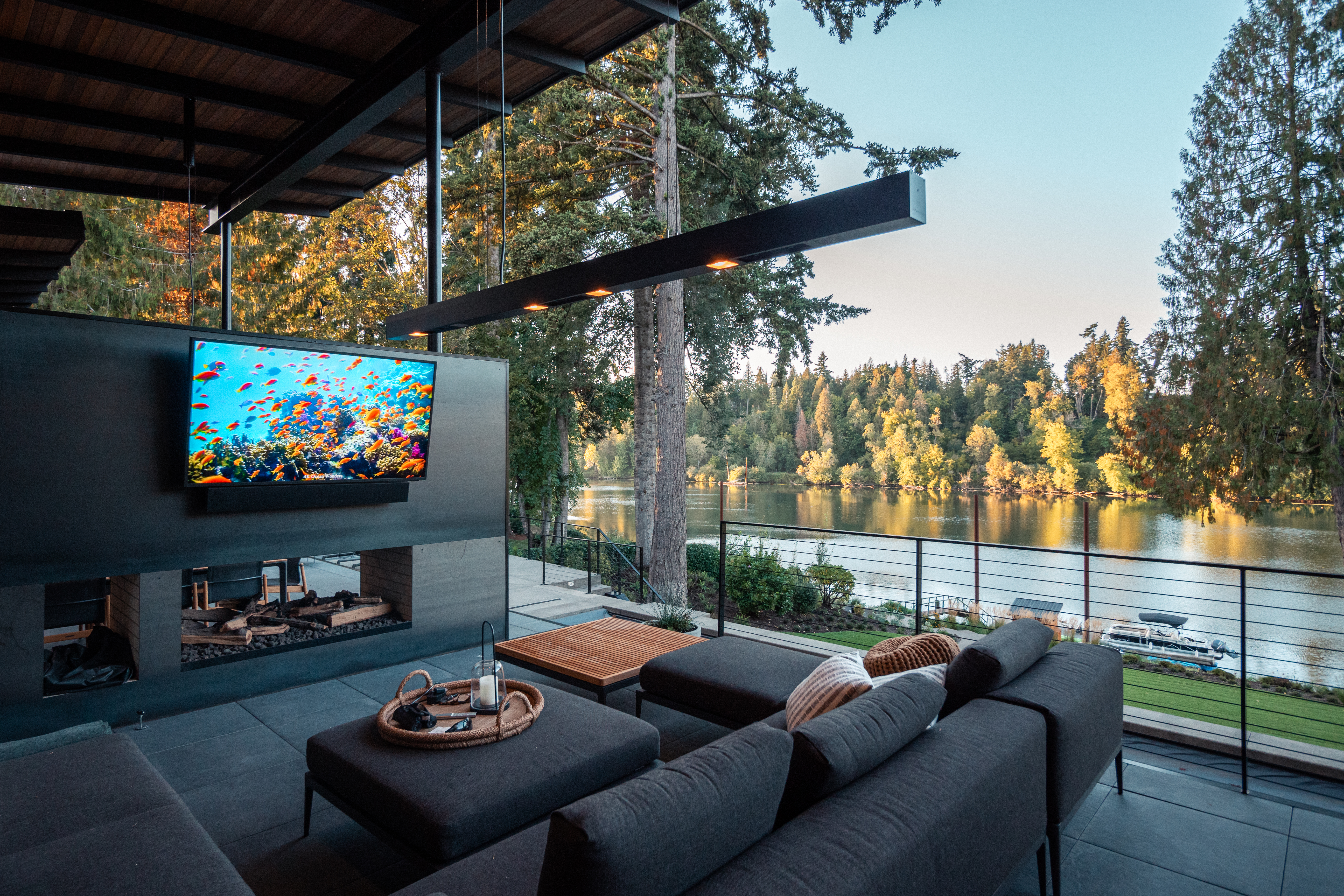
A badly placed patio heater warms the top of everyone's head and nothing else. Bromic's installation manual is explicit for the Canadian market: for cETL approval, the unit must not be installed less than 96 inches (8 feet) from the floor, and a minimum safety distance of 3 feet (900 mm) must be kept in front of it. The Tungsten Electric range carries an IPX4 water-ingress rating.
These constraints get resolved on the drawing, not on installation day. Which is exactly why appliance positions are settled before the slab is poured.
What does an evening of outdoor heating cost?
Less than you'd think. On Hydro-Québec's Rate D, in effect since April 1, 2026, electricity costs 7.065 ¢ per kilowatt-hour on the first tier and 11.142 ¢ on the second. A 4,000 W unit therefore runs between 28 ¢ and 45 ¢ an hour. Two units running four hours: under $4 for the whole evening.
What if you prefer propane?
Propane still makes sense where no natural gas line reaches, and for portable units. The Régie du bâtiment du Québec sets the terms: the cylinder must not exceed 20 lb (9 kg), the appliance must carry a certification label from a body accredited by the Standards Council of Canada, and it must never be used under a tent or an enclosed gazebo — carbon monoxide builds up there.
Electric wins over time
No cylinder to haul, no refill run on a Sunday night, no smell, no combustion. The trade-off is wiring: the 4,000 W and 6,000 W models draw 16.6 A and 25 A respectively at 240 V, which has to be planned with a master electrician. On a new build, that's a detail. On an existing patio, it's the line item that decides where the units go.
Who is legally allowed to install a gas fireplace or patio heater in Québec?
Not you, and not your landscaper. For natural gas and propane alike, the work must be carried out by a contractor holding the appropriate RBQ licence. On the electrical side, only master electricians may perform the work: the CMEQ notes that fines run from $5,000 to more than $200,000.
The regulatory frame, in plain terms
- Gas. The 2020 edition of CSA B149.1, as amended by Chapter II "Gas" of the Construction Code, has been in force in Québec since July 31, 2020. A fixed installation requires a licensed gas-appliance contractor.
- Electricity. The 25th edition of the Canadian Electrical Code has applied in Québec since March 26, 2026. Every contractor and designer must comply with it.
- Certification. The appliance must carry the label of an accredited certification body. An imported unit without that label cannot be legally installed.
What that changes about the order of work
The gas line and the electrical circuit run under the slab or behind the cladding. Deciding on them after the fact costs three times as much and leaves visible scars. In our projects, heater positions are locked in at the same time as the countertops — before excavation, never after.
How do you gain two seasons of patio, not just a few evenings?
By cutting the wind before you add heat. A patio heater on an exposed deck spends half its energy fighting drafts. Three elements work together: a motorized screen closing the side the prevailing wind comes from, a cover that keeps radiant heat inside the space, and the heating itself.
The motorized screen, the overlooked ally
A lowered screen turns an open patio into a semi-enclosed space. The gain is immediate: mosquitoes vanish in June, the wind drops in September, and radiant heat stops escaping. We covered the models and the use cases in our guide to motorized Phantom Screens, and the full range lives on our motorized screens page.
The cover, for holding out through October
A bioclimatic pergola with adjustable louvres closes the sky when it rains and opens it when it doesn't. Paired with patio heaters fixed into the structure, it keeps the terrace usable almost until the first snow. Our article on the BT Italia bioclimatic pergola explains how the structure behaves in our climate.
Heating, last
Once the wind is cut and the sky is managed, the power you need drops. That's the right order: shelter first, then heat. The whole range is on our premium outdoor heaters page.
On site: St-Germain project, Blainville
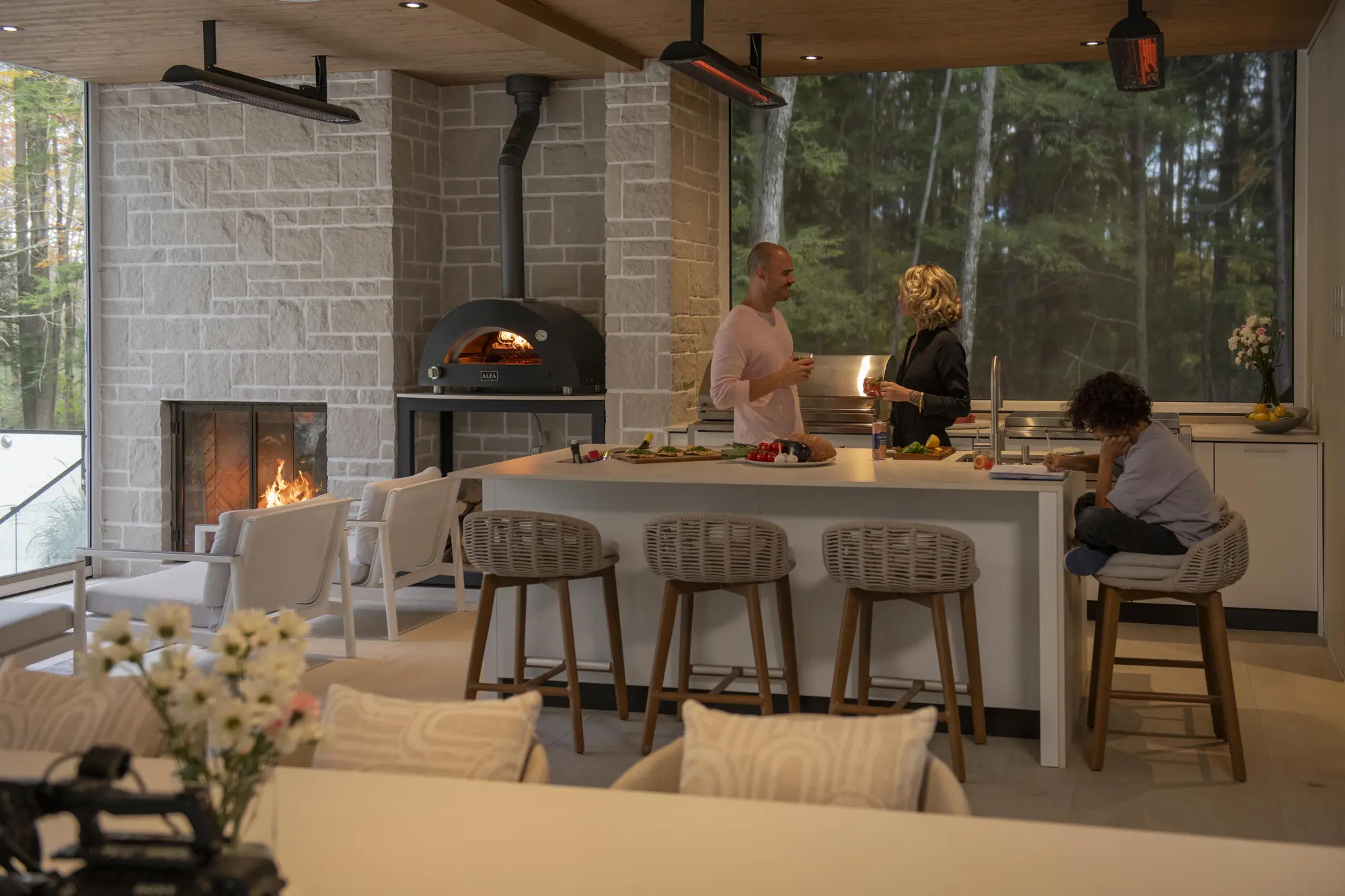
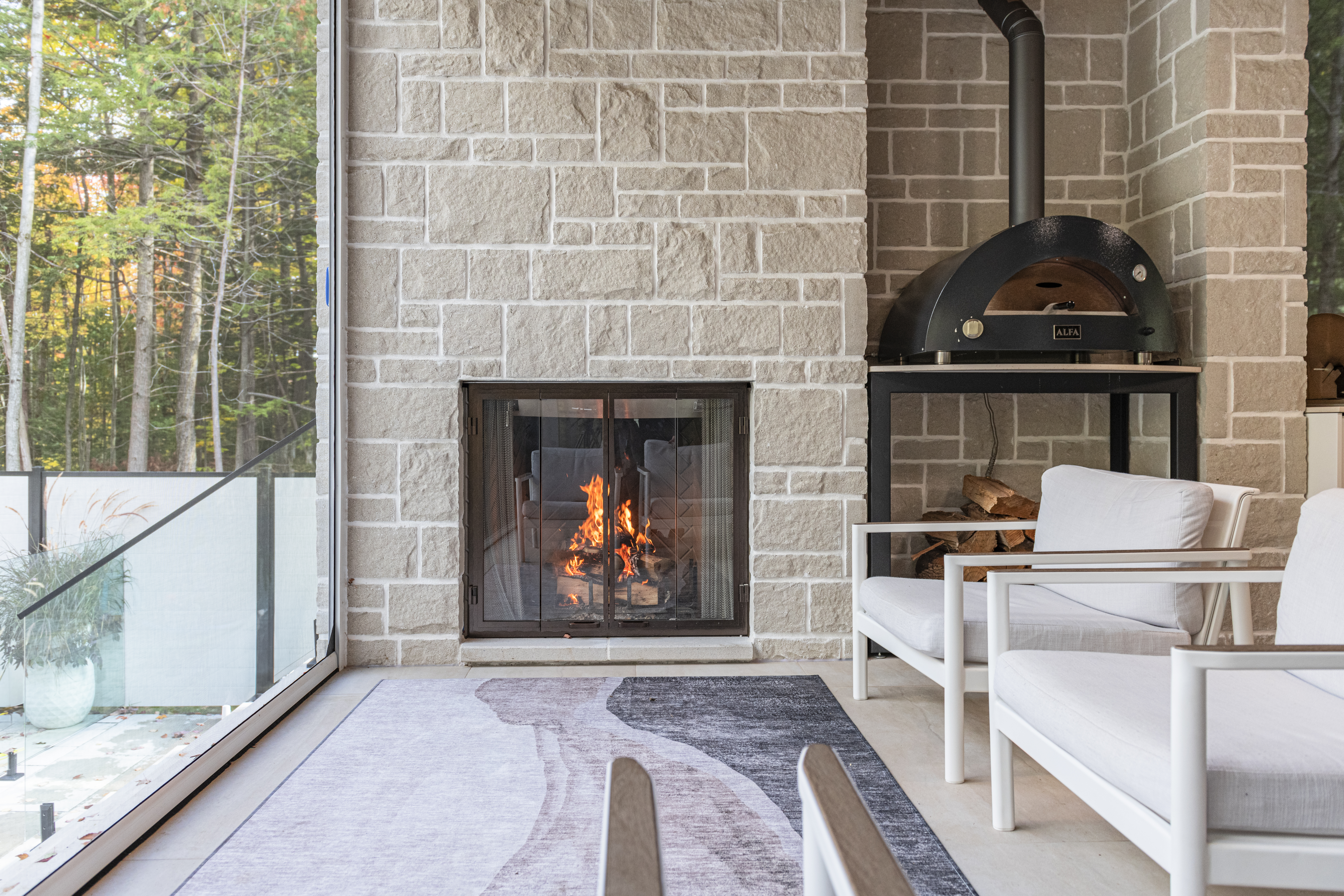
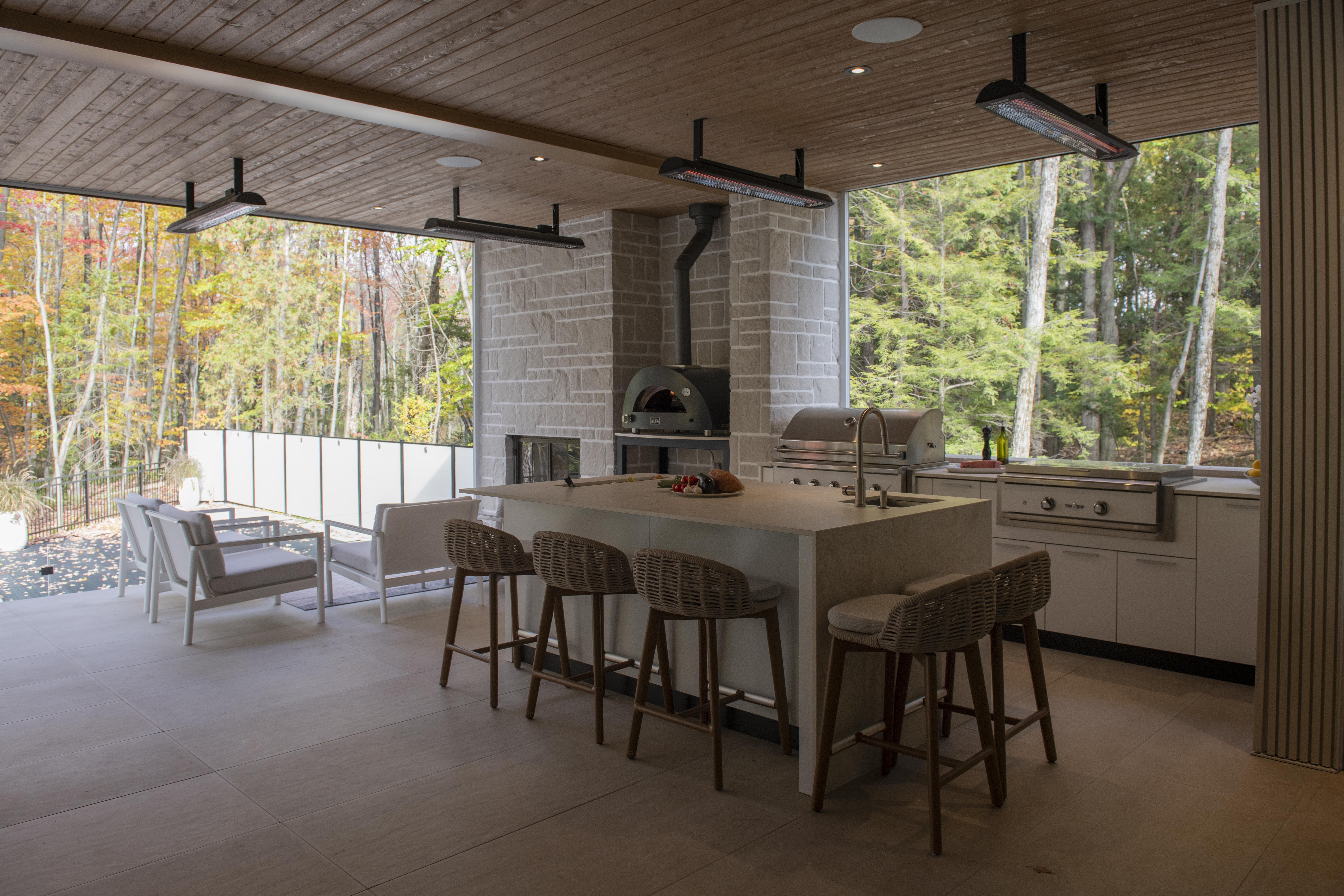
Blainville is off the island, which made a Heat & Glo wood-burning outdoor fireplace possible — a choice that would be illegal in Montréal. The rest of the summer yard was designed as one piece: a Station Grill kitchen with a Dekton ultra-compact countertop, a Delta Heat barbecue, a built-in Alpha wood-fired oven, motorized Phantom Screens and Bromic Tungsten patio heaters.
The lesson from that job is the sequence: screens before heaters. Once the exposed face was closed off, two Tungsten units did the work the original calculation had assigned to four.
Frequently asked questions
Can you install a gas outdoor fireplace on a condo balcony?
Technically yes; legally it depends on your condo board and the building's own rules, which override municipal regulations. A certified propane fire table with a 20 lb maximum cylinder is the solution most often approved. Get it confirmed in writing before you buy.
Does an electric patio heater really work in November?
Yes, provided it's correctly sized and sheltered from wind. Infrared warms people, not air: the ambient temperature can stay low while you stay comfortable. On an open, windy patio the effect collapses — which is why screens matter.
Do the units have to come inside for winter?
Fixed patio heaters designed for outdoor use stay put year-round; the Tungsten Electric range carries an IPX4 rating. Freestanding or wheeled units are better stored away. Fibre-reinforced concrete and 304 stainless fireplaces winter outside, covered, with the burners protected from standing water.
Natural gas or propane for an outdoor fireplace?
Natural gas if the line reaches your property: no cylinder, no refills, stable running cost. Propane for lots with no connection and for units you want to be able to move. Most quality fireplaces, Solus Decor's included, come in both versions.
How many units does a 30 m² patio need?
Three 4,000 W units spread out rather than two large ones in the same spot, bearing in mind that published coverage assumes a sheltered space. On an exposed patio, allow a margin. A project manager runs that calculation on the drawing, factoring in orientation and prevailing winds.
Extending the season is a design decision
The right appliance in the right place is the difference between a patio you look at and a patio you live in. Our project managers calculate the output, verify your municipality's rules and coordinate the gas contractor or the master electrician. Write to us with the dimensions of your space — we'll start there.