04 — Articles
Motorized Screens in Québec: The Complete Guide (Phantom and Wizard)
A motorized screen is a mesh panel held in side tracks that drops from a headbox at the touch of a remote and disappears when you don't want it. In Québec, it's what separates a patio you abandon at 7 p.m. from a patio where you eat dinner. In 2024, the province reported 81 cases of West Nile virus infection — and the Québec government explicitly recommends installing screens in good condition. Here's how to choose between Phantom Screens and Wizard, and what nobody tells you about the warranties.
What exactly is a motorized screen?
It's a three-part system: an aluminium headbox holding the rolled mesh, two side tracks that hold the edges, and a tubular motor inside the roller. The mesh goes down and up on a remote. Closed, it turns an open patio into a semi-enclosed space; open, it's invisible.
The detail that changes everything: captured mesh
On an entry-level screen, the mesh floats between two guides and pops out of its track at the first gust. Serious systems use captured mesh: the edge is welded into a bead that slides inside a closed channel, impossible to dislodge without taking the track apart. Wizard describes its system as mesh locked into the track at all times. That's the first thing to check — before the design, before the price.
The motor is almost always a Somfy
Phantom and Wizard both motorize their screens with Somfy motors. Phantom names the model: a Maestria 50 RTS with obstacle detection — the mesh stops if something blocks its path. Somfy warrants its motors and controls for 5 years. That's good news for long-term service: the parts are standard and available across North America.
Phantom Screens or Wizard: which one should you choose?
Both are Canadian manufacturers from British Columbia, both motorize with Somfy, and both cover very large openings. The difference comes down to three concrete points: maximum width, what the warranty actually covers, and whether a wind-tested manual version exists.
| Phantom Screens | Wizard Screens & Shades | |
|---|---|---|
| Origin | Abbotsford, B.C., since 1992 | Burnaby, B.C., over 25 years |
| Motorized screen — max size | 40 ft wide × 16 ft tall | 30 ft wide × 16 ft drop |
| Motor | Somfy Maestria 50 RTS, obstacle detection | Somfy |
| Warranty | Lifetime on components, mesh excluded; labour 24 months | Limited lifetime on all components + 10 years on paint finish |
| Wind-tested manual version | No published wind rating | VistaView: tested at 100 mph (≈ 161 km/h), up to 29 ft wide |
An honest note on the Phantom warranty: it is lifetime and tied to you, the original purchaser, in your home — it transfers neither to the next owner nor to your children. And it excludes the mesh, which is the wear part. It's written plainly on their warranty card, and it's rarely mentioned in a showroom. Wizard, for its part, covers all components for life without excluding the mesh.
A warning about product-line names
You'll see names like "Executive," "Serenity" or "Professional" presented as Phantom product lines. Those are dealer names. Phantom classifies its products into five categories only: door screens, oversized door screens, motorized screens, window screens and wood window screens. Always ask for the official category and the maximum dimensions, not a marketing label.
Which mesh: insect, solar or privacy?
The mesh decides everything: what you see, what you feel and what your neighbours notice. It's defined by its openness factor — the proportion of empty space in the weave. The higher the openness, the more you see through; the lower it is, the more heat and sightlines you cut.
The three families, in numbers
| Mesh type | Openness | What it does |
|---|---|---|
| Insect | 42 % to 56 % | View almost intact, air moves through, up to 55 % less UV |
| Solar | 25 % | Up to 80 % of the heat blocked per Phantom, up to 95 % of UV |
| Privacy | 0 % to 10 % | A textile wall: 90 % to 100 % of sun and sightlines cut |
At Wizard, the meshes carry manufacturer names you can verify: TuffScreen 17×13 in vinyl-coated polyester for insects, No-see-um 20×20 for biting midges — the very tight weave that stops the insects ordinary screens let through, a real issue in the Laurentians and the Eastern Townships — and Phifer's SunTex 80, 90 and 95 solar meshes.
What Phifer's data actually says
Phifer publishes measured figures rather than slogans. SunTex 80 has an openness factor of roughly 25 % and blocks about 75 % of UV; SunTex 90 drops to 10 % openness and 90 % UV blocked. Both are warranted 10 years in exterior use. A SunTex 90 in front of a glass wall brings the whole assembly's solar heat gain coefficient down to between 0.15 and 0.21, depending on the glass and the mesh colour.
In practice: if your patio faces west and bakes from 3 to 7 p.m., solar mesh isn't a luxury. If it's shaded and the problem is mosquitoes, insect mesh is enough — and you keep the view.
Is it really worth it in Québec?
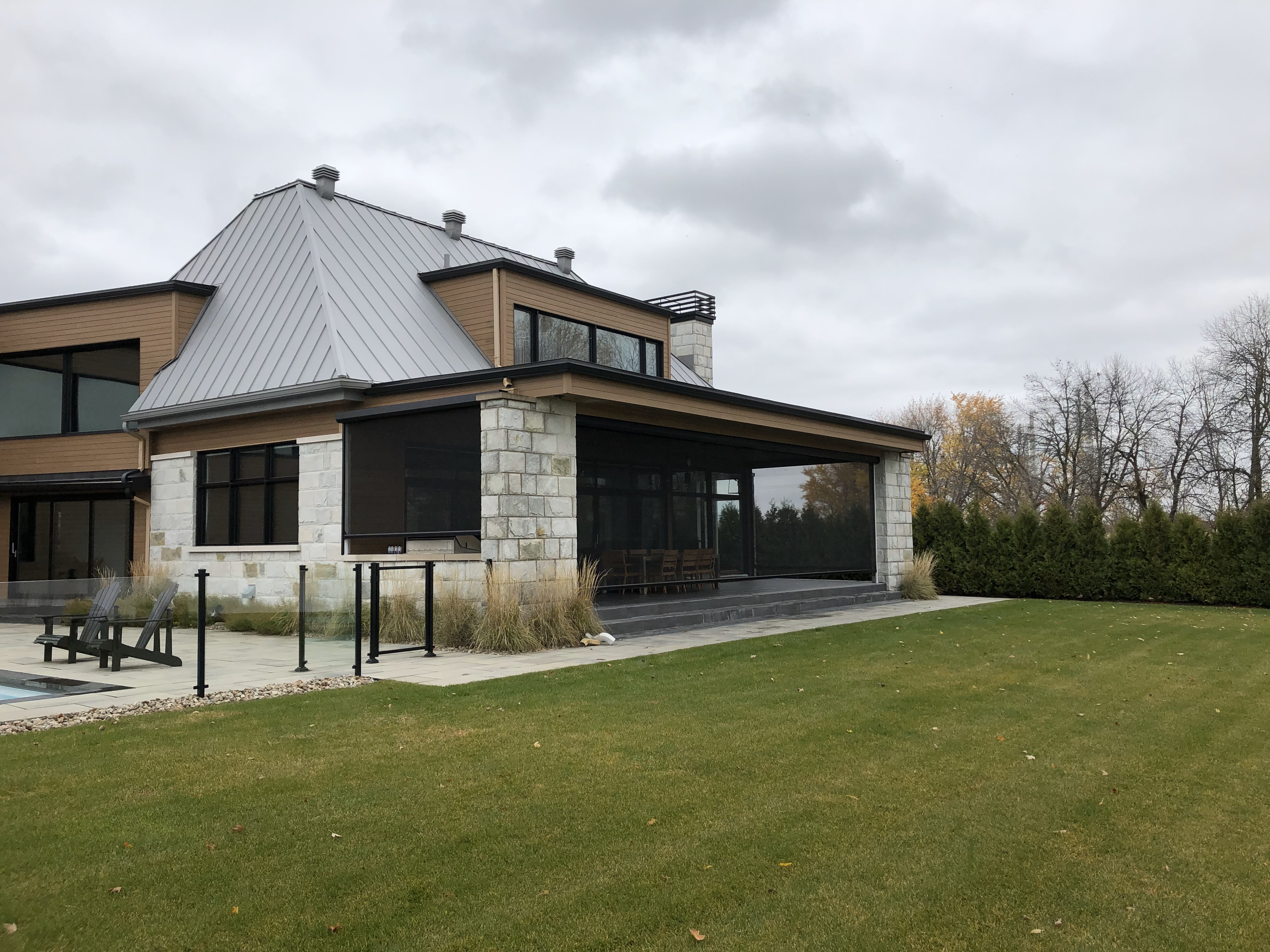
Yes, and not only for comfort. In 2024, Québec reported 81 West Nile virus infections — a 4.5-fold increase in locally acquired cases over 2023. Seven cases in ten presented as a neurological syndrome, with a median age of 64. The Québec government puts installing screens in good condition at the top of its protection recommendations.
When the mosquitoes are actually out
Transmission runs from summer through to the first autumn frosts, and mosquitoes bite mostly at sunrise and sunset — exactly the two moments a patio gets used most. In 2023, human cases spread from mid-August to early October. Put differently: the period when a screen makes a difference is also the best part of the year.
The gain nobody calculates
A lowered screen doesn't just block insects: it cuts the wind. On a heated patio, that changes the maths. We've seen it on our own jobs — once the exposed face is closed, it takes noticeably less heating output for the same comfort. It's the principle we set out in our guide to outdoor fireplaces and patio heaters in Québec: shelter first, heat second.
How long does it last, and what's actually covered?
The hardware lasts decades; the mesh is a wear part. That's the distinction most "lifetime" warranties blur. Phantom warrants its components for life but excludes the mesh, with labour covered for the first 24 months. Wizard covers all components for life and adds 10 years on the paint finish. Somfy motors are warranted 5 years.
The right questions to ask before signing
- Is the mesh covered, and for how many years?
- Is the warranty transferable to the next owner?
- Is labour included, and for how long?
- Exactly which mesh, with its manufacturer name and openness factor?
- Can the mesh be replaced in place, or does the headbox have to come down?
How does installation work, and what has to be planned?
Three things get decided before the work starts: where the motor's power feed runs, how the headbox integrates with the structure, and whether the tracks are surface-mounted or recessed. In new construction or a major renovation, tracks disappear into the posts and the headbox into the soffit. On an existing structure, everything mounts on the surface — perfectly clean, but visible.
Sensors, decided at quotation stage
Somfy offers a wireless wind sensor (Eolis 3D WireFree RTS, IP44 rated, 5-year warranty) that retracts the screen automatically when the wind picks up, plus a combined sun-and-wind sensor. On a rooftop terrace or an exposed façade, this isn't a gadget: it's what stops an October gust from wrecking a 30-foot mesh while you're at work. Budget for it up front, not later.
The sequence that saves you from redoing everything
Screens, cover, heating — in that order. A bioclimatic pergola takes screen tracks in its posts and heaters in its structure; the reverse means drilling. Our project managers draw all three layers together.
On site: St-Germain project, Blainville
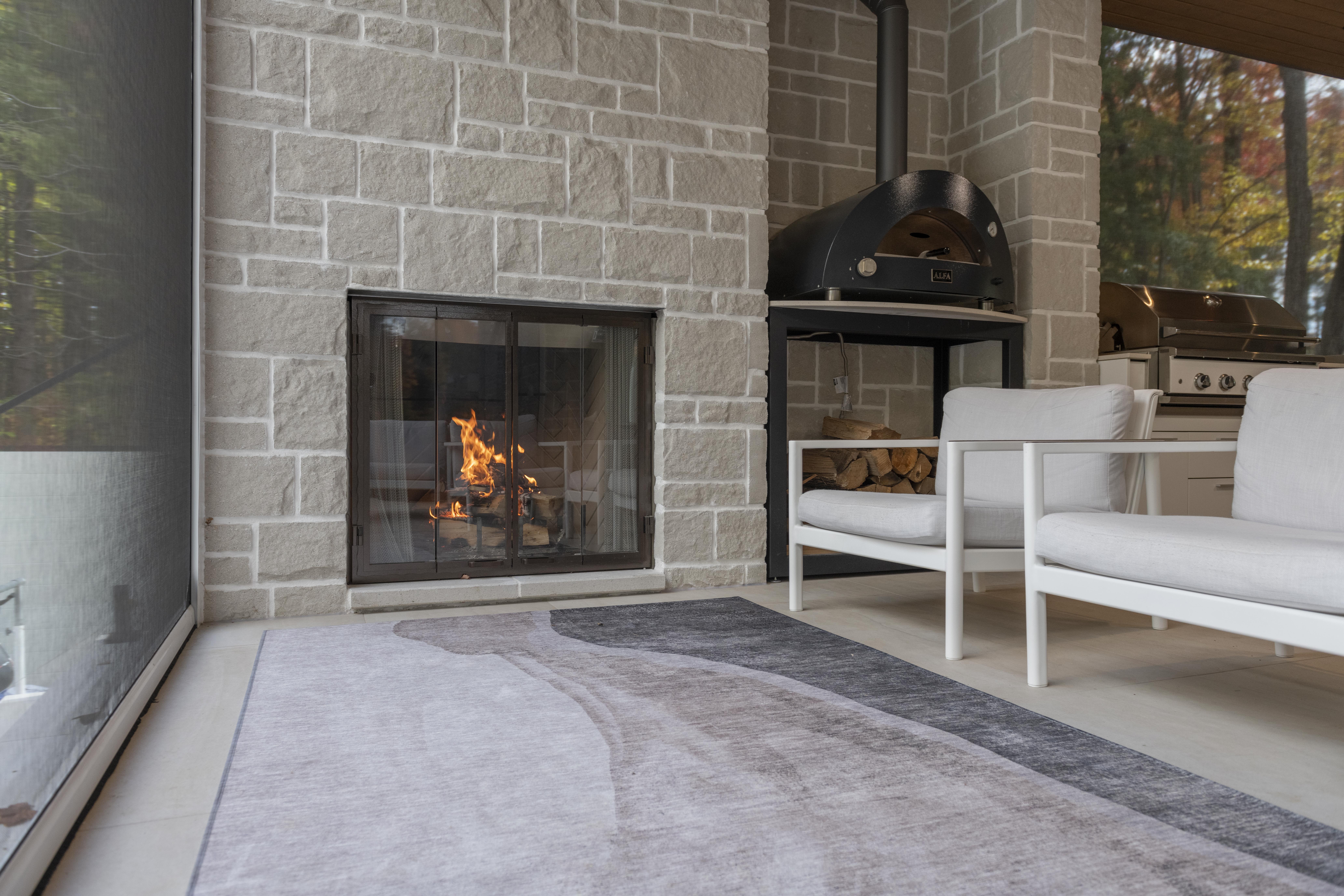
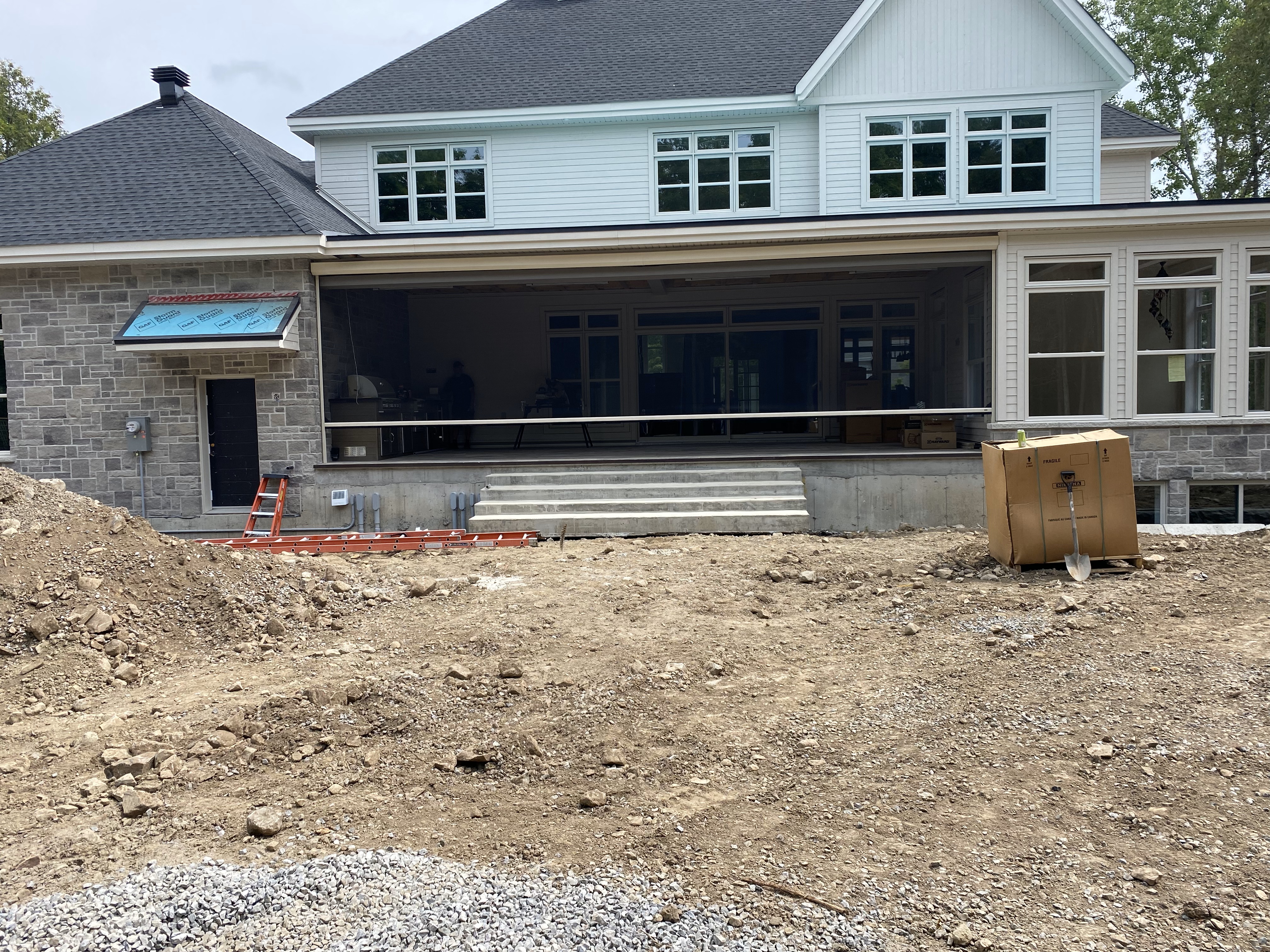
The Blainville summer yard includes a Station Grill kitchen with a Dekton countertop, a Delta Heat barbecue, an Alpha wood-fired oven, a Heat & Glo outdoor fireplace and Bromic Tungsten patio heaters. Motorized Phantom Screens close off the most exposed face.
What we took away from that job: the screens went in before the heaters, and the output calculation was redone afterwards. Two Tungsten units did the work of the four originally specified. The screen paid for part of itself in appliances we didn't have to buy.
Frequently asked questions
Do the screens have to be retracted for winter?
Yes — you roll them up into the headbox and leave them there. Rolled mesh is protected; it's mesh left deployed under snow and ice that gets damaged. A wind sensor also handles autumn storms when you're not home.
What's the widest opening a single screen can cover?
Up to 40 feet wide by 16 feet tall with Phantom, and 30 by 16 with Wizard. Beyond that you split into two screens with an intermediate post — which is often preferable anyway: two smaller meshes handle better and cost less to replace.
Will a motorized screen hold up to Québec wind?
Phantom publishes no wind rating for its motorized screens. Wizard advertises a 100 mph test, but on its manual VistaView line. On an exposed façade, the real answer isn't a rating: it's a wind sensor that retracts the screen automatically.
Can you keep the view with a mesh that blocks the sun?
Partly. A solar mesh at 25 % openness lets you see the landscape from inside during the day, with a tinted-glass effect. A privacy mesh at 0–10 % openness does not: that's a wall. The trade-off gets chosen on a sample, in daylight, not from a catalogue.
How long does a mesh last?
Phifer's SunTex solar meshes are warranted 10 years in exterior use. An insect mesh properly retracted each winter generally lasts as long. Plan for replacement as routine maintenance, not as a breakdown — and check before you buy whether your warranty covers it.
Closing the patio without closing it in
The right screen is the one you forget: invisible by day, decisive at sunset. Our project managers take the dimensions, compare meshes on samples and coordinate the install with the rest of the patio layout. The full range is on our motorized screens page, with the detail of our Wizard Screens & Shades partnership.
And if the project also involves the indoors, our sister brand Noréa Foyers handles heating the house while we handle the yard.