04 — Articles
Bioclimatic Pergola in Québec: The BT Italia Buyer's Guide
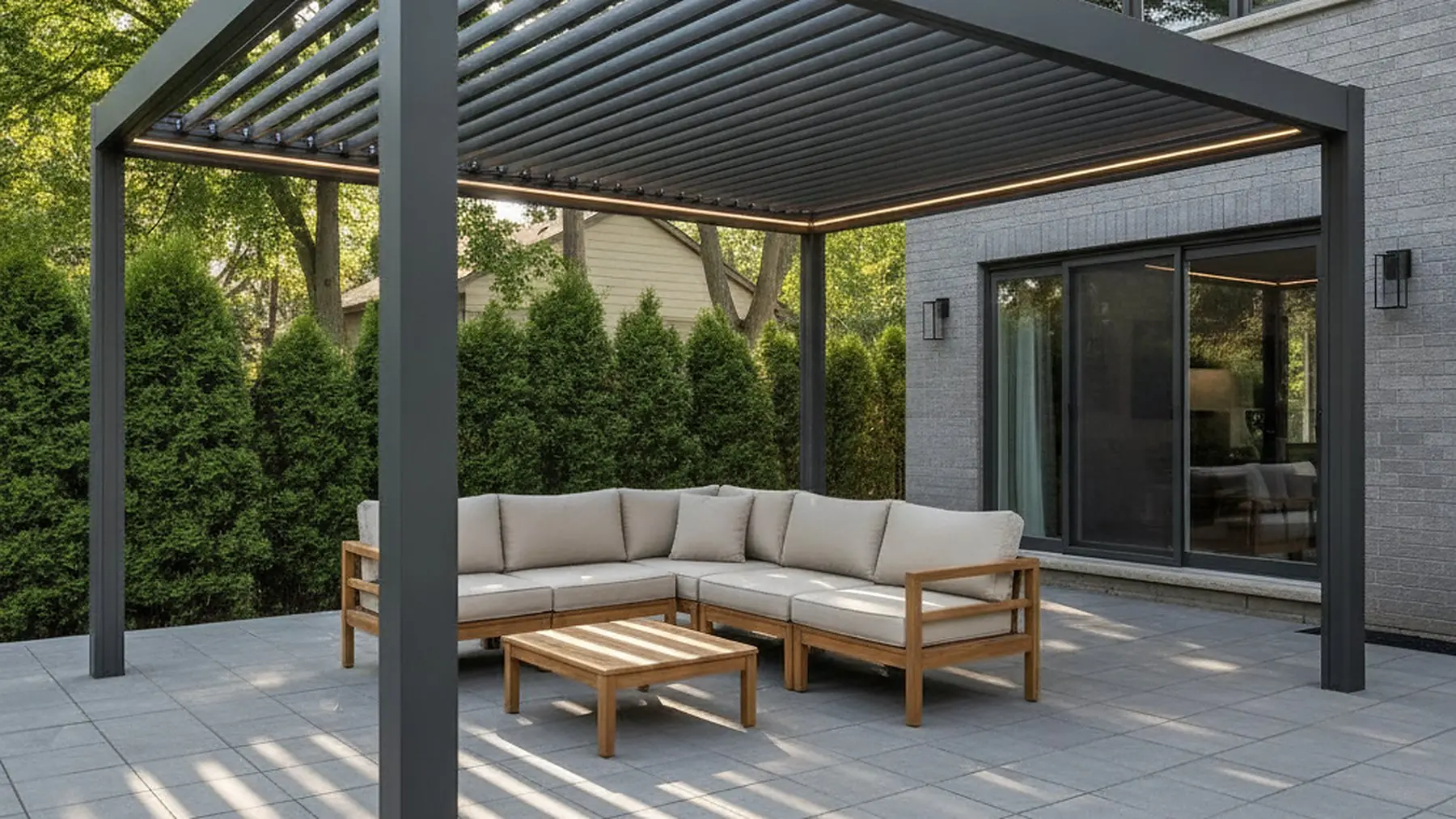
A bioclimatic pergola is a structure whose roof is made of pivoting aluminum louvres, so you control sun, rain and ventilation. In Québec, one number settles the purchase: the maximum snow load the manufacturer guarantees for your model at your exact dimensions. Without that published figure, you have a brochure, not a comparison.
What does bioclimatic actually mean?
It means one specific thing: the roof is built from aluminum louvres that rotate. Closed, they form a watertight deck that drains into the posts. Open, they create a draft that pulls accumulated heat out from under the structure. BT Italia's R600 Pergoklima rotates from 0° to 140° on 22 cm by 4 cm louvres; Renson's Algarve and Camargue open through 150°.
That is neither a fixed roof nor a retractable canopy. It is the only one of the three that claims to do both jobs, and the only one whose performance depends on a mechanism.
| Roof type | What it does | Its limit in Québec |
|---|---|---|
| Adjustable louvres (bioclimatic) | Rotates 0° to 140–150°, watertight closed, drainage built into the posts | Rated snow load falls fast as the span grows |
| Fixed roof (panels, glass, fixed slats) | Permanent cover, no moving parts | No control over sun or ventilation |
| Retractable canopy | Folds away completely, light structure | Carries no snow; the fabric comes off in the fall |
Snow load: the question that settles everything
The right question is not "does it handle snow," but "how many kilopascals, over what span, on which model." The Code de construction du Québec adopts Appendix C of the National Building Code, which assigns every locality a ground snow load Ss and an associated rain load Sr, both on a 50-year return period.
The starting values in Greater Montréal
| Locality | Ss — ground snow (kPa) | Sr — rain load (kPa) | Wind 1/50 (kPa) |
|---|---|---|---|
| Montréal | 2.6 | 0.4 | 0.42 |
| Outremont | 2.8 | 0.4 | 0.42 |
| Laval | 2.6 | 0.4 | 0.42 |
| Brossard | 2.4 | 0.4 | 0.42 |
Values from Cecobois's city-by-city compilation of NBC 2015 climatic data. The gap between Brossard and Outremont is 0.4 kPa across one bridge: a pergola sized for the South Shore is not automatically compliant on the Plateau.
From ground to roof: the load path
Ss is a ground load. The design load on a roof is lower, because wind sweeps some of it off. Part 9 of the Code, which covers small buildings, uses article 9.4.2.2: S = Cb × Ss + Sr, where Cb is 0.45 for a roof no more than 4.3 m wide and 0.55 for everything else. In Montréal that gives 1.57 kPa, roughly 160 kg/m² or 33 lb/ft², and 1.83 kPa (187 kg/m², 38 lb/ft²) past 4.3 m.
Part 4, which an engineer applies the moment they seal a calculation, uses S = Is[Ss(Cb Cw Cs Ca) + Sr]. With Cb = 0.8 for small roofs, Cw = Cs = Ca = 1.0 and an importance factor Is of 1.0, the same Montréal pergola reaches 2.48 kPa, about 253 kg/m² (52 lb/ft²). That band — 160 to 255 kg/m² — is what the manufacturer's number has to beat.
Two caveats. Ca is only 1.0 if nothing above or beside the pergola drifts snow onto it: a unit attached under a sloped roof that sheds gets a sliding-snow accumulation, and the number climbs. And Is drops to 0.8 if the structure is classed low importance — an engineer's call, never a salesperson's.
What a manufacturer must publish to be credible
Four things, none optional: a maximum allowable snow load in kPa, kg/m² or lb/ft², given for each span-and-projection combination rather than for a whole product line; the louvre position that figure applies to; the safety factor used; and the exclusion conditions. A brochure line saying "snow resistant" is worth nothing to an inspector or an insurer.
What BT Italia, Renson and Cubrics actually publish
| Manufacturer | Published snow load | Other published data |
|---|---|---|
| BT Italia (BT Group) | No figure found. The R600 Pergoklima product page lists "snow resistance" as a benefit without quantifying it, and the model's public technical sheet does not address it. | Louvres 22 × 4 cm, 0–140° rotation, maximum module 4.20 × 6.00 m on four posts (8.00 m on six), structure weight 30 kg/m², 20 × 20 cm perimeter gutter, minimum two downspouts, low-voltage linear motor. |
| Renson | Full tables, dimension by dimension. Algarve: 300 kg/m² at 2400 × 2615 mm, 34 kg/m² at 4500 × 6055 mm; with the additional beam, 584 kg/m² at 3200 × 2615 mm and 51 kg/m² at 6000 × 6055 mm. Camargue and Camargue Skye: 866 kg/m² at 2000 × 4000 mm, 41 kg/m² at 4500 × 6200 mm. | Wind guarantee with blades closed 120 km/h (160 km/h retracted); blades should not be operated above 50 km/h; Fixscreen 60 km/h; drainage 120 l/m²/h; safety factor 1.5 in bending. |
| Cubrics | No technical data published on the public site. | Designed and built entirely in Québec, in Granby; aluminum or composite slats; the range is fixed-slat rather than bioclimatic. |
That contrast is the most useful thing in this article. Because Renson publishes its tables, you can confirm before signing that an Algarve at 4500 × 6055 mm, rated 34 kg/m², sits far below the Montréal design load — so you shrink the module, add the beam, or add posts. BT Italia advertises snow resistance without publishing the number; until it is in writing for your span, the structure is not comparable. Cubrics does not publish its data either.
One line worth catching in Renson's North American Camargue sheet: it excludes sites where the ground snow load exceeds 22 lb/ft² — about 1.05 kPa — and where the pergola is surrounded by obstacles, tall conifers for example, that stop snow from blowing off. Montréal sits at 2.6 kPa, so the first half of that condition is always true here. Your yard's real exposure decides the rest.
Wind, water and anchoring
A wind rating is not a design pressure
The 1/50 reference hourly wind pressure in Montréal is 0.42 kPa, roughly a 90 km/h mean hourly wind at standard air density; gusts run higher. That is not the same unit as a manufacturer guarantee. Renson's "wind guarantee of roof with blades closed up to 120 km/h" is a speed, not a design pressure, and it assumes anchoring exactly per their details.
Gutters and drainage, the February blind spot
A closed bioclimatic pergola is a roof, and a roof produces water that has to go somewhere. Renson rates the Algarve's drainage at 120 l/m²/h and requires one downspout under 16 m² of cover, two above; BT Italia integrates a 20 × 20 cm perimeter gutter into the posts and likewise calls for two outlets on the R600. What matters here is what that water does in February: a downspout discharging onto a slab or a stair builds an ice sheet.
Footings well below frost depth
Table 9.12.2.2 of the Code de construction du Québec sets minimum foundation depth by soil type, drainage and whether the adjacent space is heated; in several cases it requires at least 1.2 m, or the frost penetration limit if that is deeper. Montréal runs about 607 freezing degree-days, corresponding to roughly 0.8 m of penetration — but the APCHQ notes frost has historically reached 2.35 m in Montréal. The mechanism tolerates no differential movement: poured footings or helical piles bearing below frost, never patio blocks set on grade.
Screens, lighting, heat and motorization
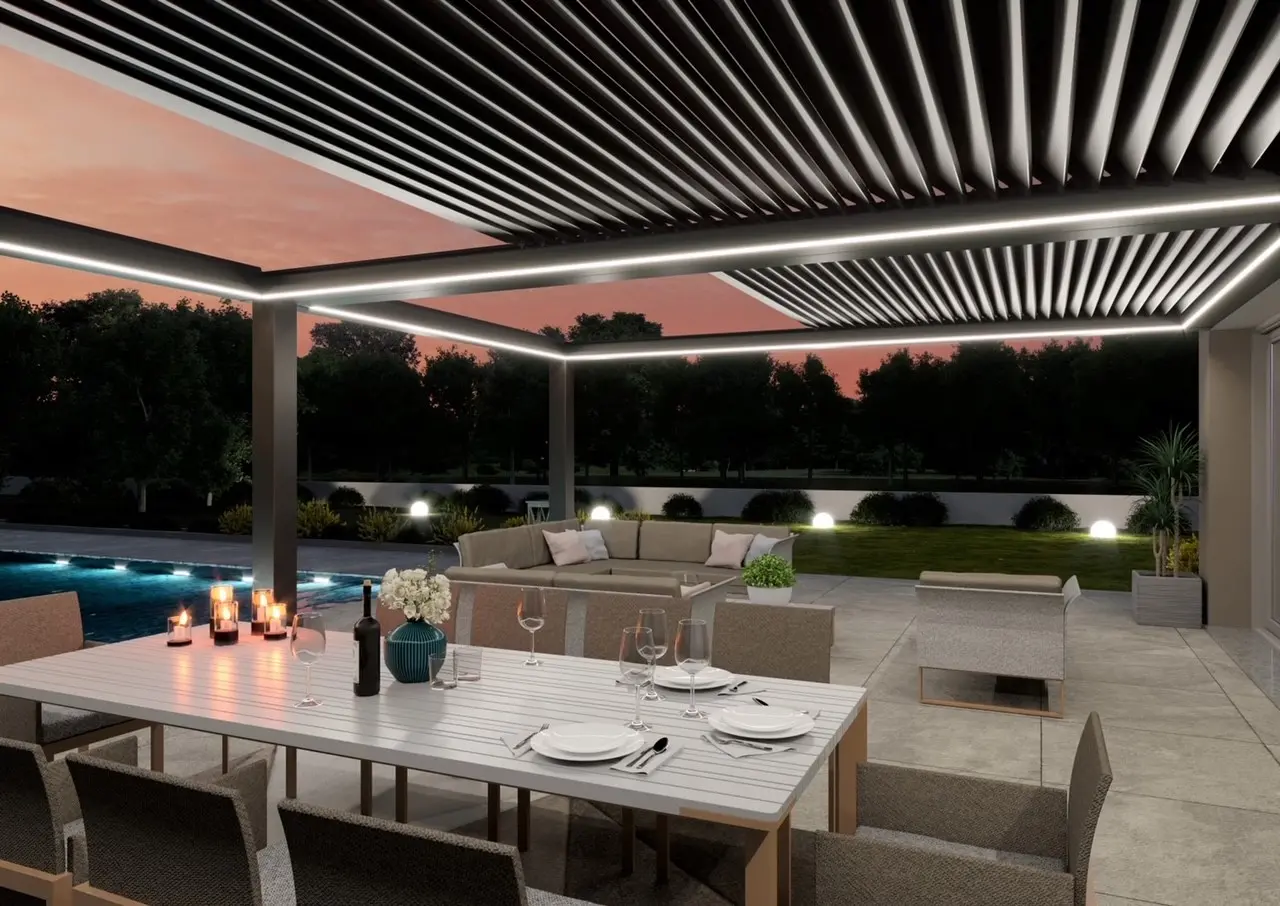
The accessories are not decoration; they are what lengthens the season. With no screen and no heat, a bioclimatic pergola is comfortable from May to September here. Add a motorized side screen that kills the wind plus an infrared beam heater and you pick up both shoulder seasons. Renson builds its Fixscreen, guaranteed closed to 60 km/h, into the same structure as its LED lighting.
Louvre rotation is motorized — a low-voltage linear motor on BT Italia, 230 V with radio or app control on Renson. That means a dedicated circuit, pulled before the posts are grouted. The sensors earn their price: Renson's wind sensor retracts the screens, and its rain sensor doubles as a snow detector thanks to its built-in temperature probe. It does not replace a structural calculation.
Do you need a permit?
For a permanent structure, yes in nearly every case, and the rules change from one borough to the next. The Rivière-des-Prairies–Pointe-aux-Trembles info sheet shows the typical demand: an authorization certificate, detailed plans, a location certificate, and — the item that surprises most clients — an attestation from a member of the Ordre des ingénieurs du Québec confirming the structure carries Code loads. It also sets a maximum height of 3 m from the floor, a 1.5 m setback from the property line, and architectural review past 12 m².
Attached versus freestanding changes the file. Attached, the pergola becomes an extension of the building: wall fastening, flashing, and above all snow sliding off the roof above. Freestanding, it is usually treated as an accessory structure with its own setbacks. Settle that before you order aluminum.
Maintenance: light, but not zero
Two rinses a year handles the louvres; the perimeter gutter needs more. Conifer needles and maple keys plug the downspouts, and a plugged gutter holds water that freezes. In spring, check anchor torque after the freeze-thaw cycle and inspect the gaskets between louvres — those age, not the aluminum. For snow removal, follow the manufacturer's written instruction: a shovel on aluminum louvres means a bent mechanism. If your configuration is rated below the local design load, clearing snow stops being a comfort choice and becomes a condition of use that belongs in the contract.
From the field
We ask for the table, not the brochure. Before we propose a configuration, we make the manufacturer give us the row matching the project's real span and projection. When the table exists, as it does at Renson, the conversation takes ten minutes. When it does not, we ask in writing and wait for the answer.
The enemy is not falling snow, it is sliding snow. The problem installations are almost never freestanding pergolas in an open yard. They are units attached under a metal-clad slope that dumps in one go in March and delivers, in seconds, a load nobody calculated. We move the pergola, add snow guards to the main roof, or redo the sizing.
We pull the wiring before we pour. Motors, sensors, LEDs, heat: the conduit runs inside the post, and the post gets grouted to the footing. That oversight costs a slab.
Common questions
Will a bioclimatic pergola survive a Québec winter?
Some will, if they are sized for it. The deciding factor is not the brand but the span: the same range can be rated 300 kg/m² on a small module and 34 kg/m² at its maximum. In Montréal the roof design load runs from 160 to 255 kg/m² depending on method. Compare those two numbers before anything else.
Louvres open or closed over the winter?
Closed, by default. Renson's wind guarantees and snow load tables are stated for the roof with blades closed, and Renson advises against operating the blades above 50 km/h. None of the three manufacturers publishes an explicit winterizing instruction, though. Get the winter position confirmed in writing, with the snow-clearing procedure attached.
Can it go on an existing deck?
Rarely as-is. A wood or composite deck is sized for occupancy load, not for carrying the posts of a snow-loaded roof. In most cases the posts pass through the deck onto their own footings or piles. Settle this at the plan stage: it fixes where the posts land, and therefore the spans.
Do I need an engineer?
Often, and sometimes as a legal requirement. Several Montréal boroughs demand an attestation from a member of the Ordre des ingénieurs du Québec for a permanent shelter. Even where no borough asks, the engineer is who sets Is, evaluates sliding-snow accumulation and validates the anchoring.
Bioclimatic or fixed roof for this climate?
Bioclimatic earns its cost if you want to modulate sun and ventilation day to day. If the goal is mainly permanent cover over an outdoor kitchen, a well-drained fixed roof costs less, has fewer moving parts, and can be cleared of snow without risk of bending a mechanism.
How to decide
Work in this order. Fix the usable dimensions of the space you want covered, then ask every supplier for the allowable snow load at exactly those dimensions, in writing. Measure it against your municipality's design load — 1.57 to 2.48 kPa on the island of Montréal. Then settle anchoring, drainage and wiring. Louvre colour comes last.
At Mughet we work with BT Italia, Renson and Cubrics, and we pick the brand to suit the span and the site's exposure, not the other way around. See the full pergola range, the motorized screens and patio heaters that stretch the season, and why screens matter on a covered patio. If the pergola has to shelter a cooking zone, start with our outdoor kitchen guide and the decking and siding that goes under it. Our past projects show how these calls play out on real sites; send us your yard dimensions and we will start from the load table, not the catalogue.