04 — Articles
Bromic or Heatsail: Which Luxury Infrared Patio Heater Should You Choose?
Bromic and Heatsail both heat by infrared radiation, but they answer different questions. Bromic publishes BTUs, square-foot coverage and certified clearances: it's a performance appliance. Heatsail designs objects that light a space while they heat it: it's a piece of the build. Here's how to decide, with the numbers, for a Québec patio.
Bromic or Heatsail: what's the real difference?
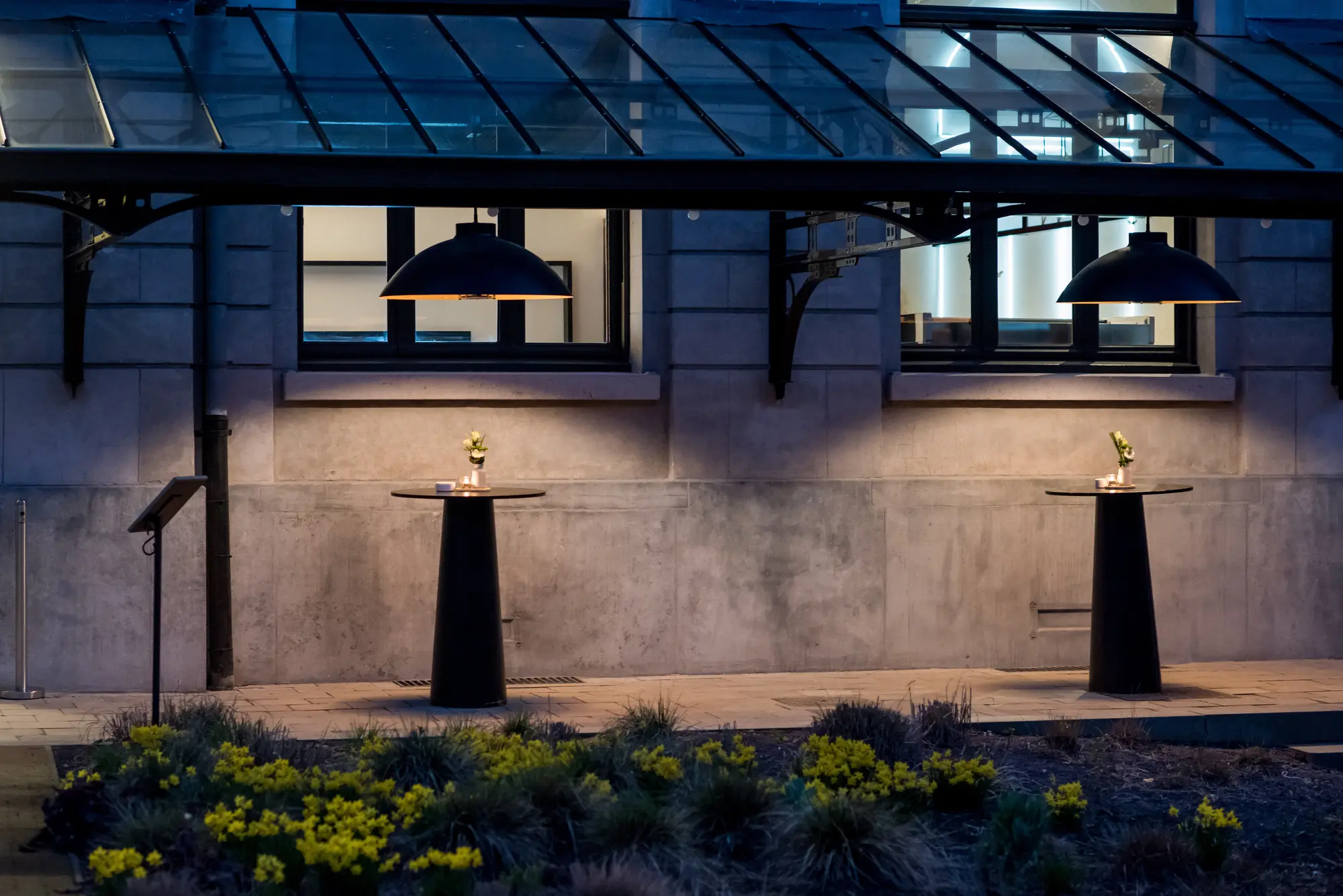
Bromic is a heating manufacturer: gas and electric ranges, standardised outputs, coverage published in square feet, Intertek certification, dimming controllers. Heatsail is a Belgian design house founded in 2012: its units are conceived as luminous furniture, often dimmable on the light side, sometimes with misting. One is chosen from a spec sheet, the other from a photograph.
What each one publishes — and what it doesn't
This is the most useful point in the whole comparison, and nobody makes it. For every model, Bromic publishes the output in watts or BTU/h, the area covered in square feet, the amperage, the ingress rating, the minimum clearances and the warranty term. Heatsail publishes a consumption figure expressed in "kWh", dimensions, and a usage note along the lines of "ideal for a table of six to twelve."
The practical consequence: you cannot directly compare coverage between the two brands, because Heatsail publishes none in square feet. Anyone showing you a table of "Bromic 130 sq ft vs Heatsail 130 sq ft" invented half the numbers. What can be compared is output and use case.
Gas or electric: the question that comes before the brand
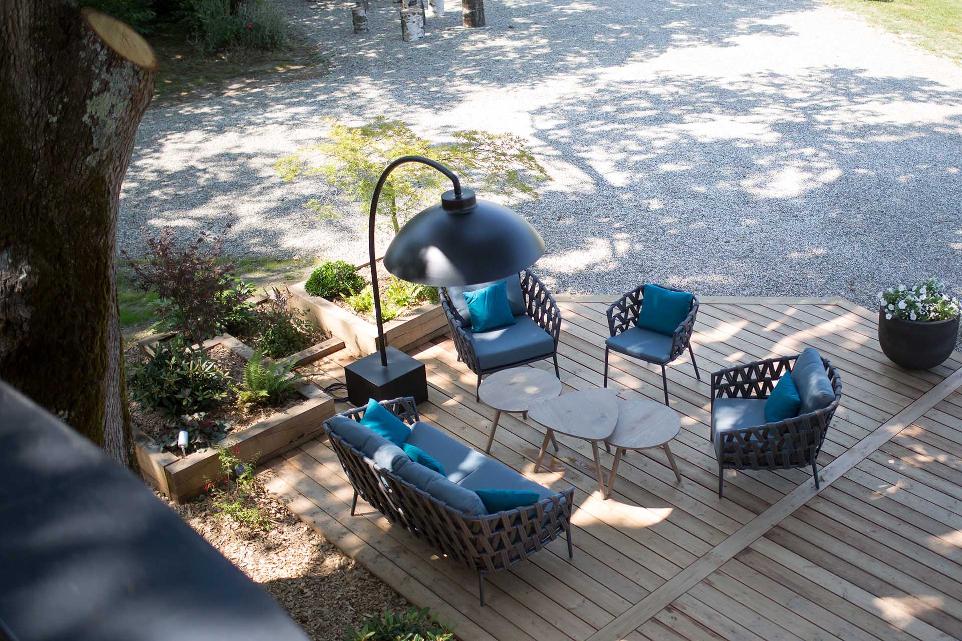
It comes first because Heatsail only makes electric units. If your patio is large and open, Bromic's gas range covers more area per appliance. If it's covered or semi-enclosed, electric wins: no combustion, no minimum ventilation to satisfy, and the heat modulates.
Bromic's gas ranges
| Model | Output | Coverage | Warranty |
|---|---|---|---|
| Tungsten Gas 300 · 500 | 26,000 · 43,000 BTU | 160 · 215 sq ft | 2 years |
| Platinum Gas 300 · 500 | 23,600 · 39,800 BTU | 160 · 215 sq ft | 2 years |
| Tungsten freestanding | 38,500 BTU/h | 215 sq ft | 1 year |
Both built-in ranges take natural gas or propane, carry an IPX4 rating and need a 110 V feed for ignition. The freestanding propane model, in 304 stainless steel, is rated for eight hours of operation on a single 20 lb tank — the unit you move to suit the evening.
The 25 % rule that decides everything
A gas appliance is certified for outdoor use only, and it cannot be installed in a residential indoor space. Under a partial enclosure, Bromic's manual is precise: either no more than two walls under a cover, or, if there are more, at least 25 % of the total wall area completely open and at least 30 % of the remainder open. On a veranda that's too closed in, the question no longer arises: it's electric.
The real cost, in Québec dollars
Bromic ranks the fuels in this order: natural gas cheapest, then electricity, then propane. For electricity we can be exact here. On Hydro-Québec's Rate D, in effect since April 1, 2026, a kilowatt-hour costs 7.065 ¢ on the first tier and 11.142 ¢ on the second: a 4,000 W unit therefore runs between 28 ¢ and 45 ¢ an hour. This is not the line item that will decide anything.
How much electric output, and at what height?
Budget one 4,000 W unit per twelve square metres. Bromic rates its 4,000 W Tungsten Electric at 130 sq ft and the 6,000 W at 160 sq ft; the Platinum range covers 65, 108 and 143 sq ft at 2,300, 3,400 and 4,500 W. On the Heatsail side, the freestanding Dome delivers 3,220 W and the Beem reaches 3,000 W or 4,000 W depending on length.
The Canadian height is not the American one
A detail most installers miss: Bromic allows wall mounting at 72 inches off the ground in the United States, but requires 96 inches in Canada for cETL certification. On a ceiling it's 96 inches on both sides of the border, with 3 feet of side clearance to combustible materials. On a low-ceilinged patio, that constraint alone can rule a model out.
The electrical circuit is not a detail
Both brands need 208 V or 240 V for the heating side — not a plain 120 V outlet. The 4,000 W Tungsten draws 16.6 A and the 6,000 W draws 25 A at 240 V; Heatsail's Dome ships at 240 V with 208 V available. In every case a master electrician pulls the circuit, as we explain in our guide to outdoor fireplaces and patio heaters in Québec.
Light, mist and presence: what Heatsail does that Bromic doesn't
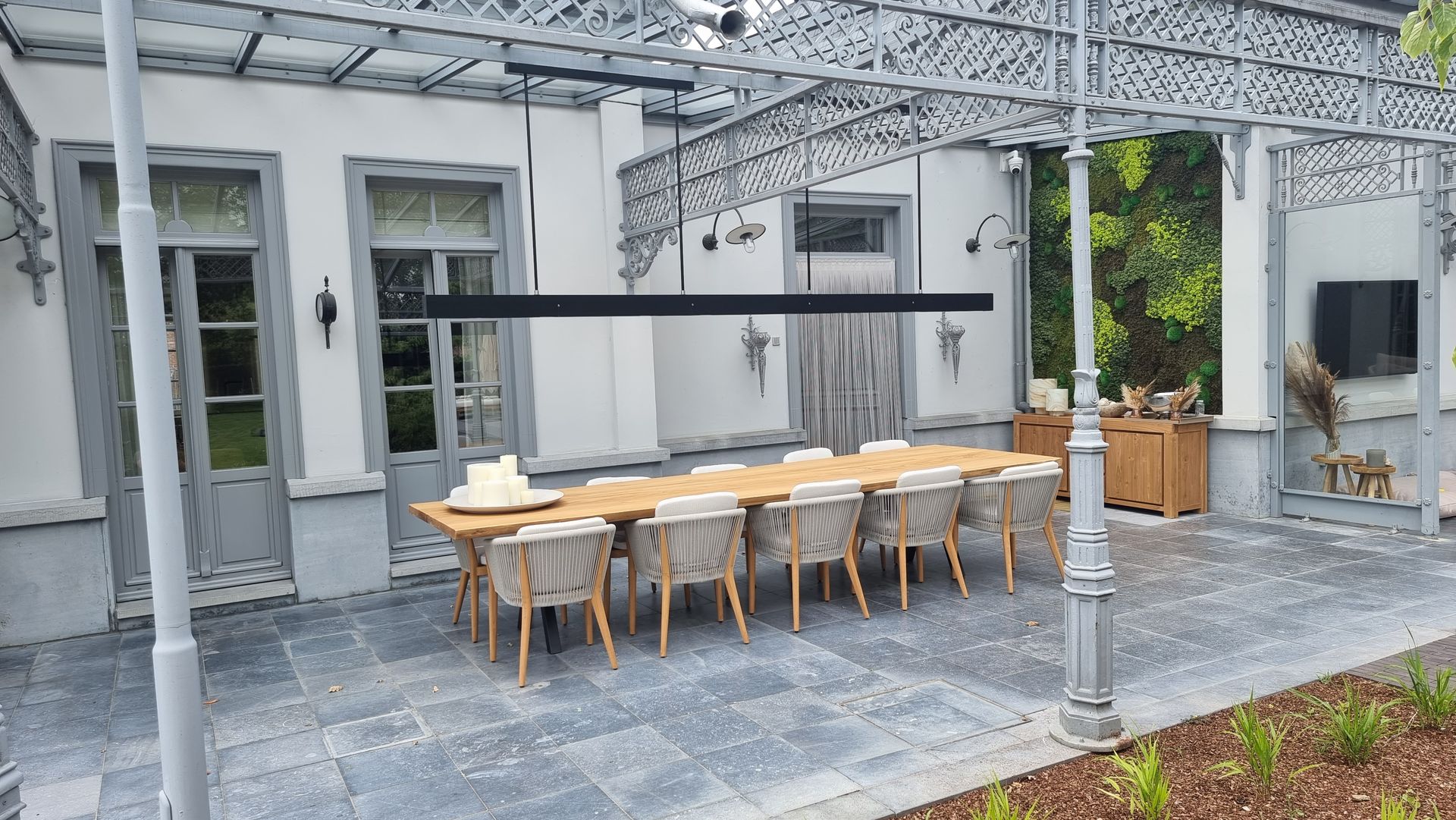
Heatsail designs units that replace the light fixture rather than adding to it. The Dome lights and heats, on separate controls. The Beem integrates 240 W of lighting on the 230 and 290 versions, and 320 W on the 390. The Disc, designed by Piet Boon, is rated for a reach of up to 15 feet. The Leaf adds misting that drops ambient temperature by as much as 15 °C in a heat wave.
The Glow, for clients who want to see nothing
The Glow ships in sets of three or five 640 W modules — 1,920 W or 3,200 W in total — arranged in a circle or a line on the ceiling. Heatsail describes it as delivering comfortable warmth without a red glow, and specifies it for covered outdoor areas. It's the answer when a client refuses to see a heater in their ceiling.
Bromic answers with the Eclipse
Bromic hasn't left the field open: its Eclipse range combines 2,900 W of heat with a 497-lumen LED at 3000 K, dimmable from 50 to 100 %, over 121 sq ft of coverage, with three heat levels. The difference remains philosophical: at Bromic, light is an added function; at Heatsail, it's the starting point of the drawing.
Which one controls better?
Bromic, by a distance, if you're talking home automation. Its Affinity controller family dims heat in 1 % increments on electric units, comes in 1, 2 and 5 channels, runs from an app, and an expansion board adds Ethernet and 0–10 V for integration into a building management system. Heatsail runs from an app and a remote, with no documented integration protocol.
Gas does not modulate
Worth knowing if gradual comfort matters to you: Bromic's gas appliances are only compatible with the on/off controller or a manual wall switch. Fine dimming is electric-only. On a patio where you move from late afternoon into the evening, you feel the difference.
So which one for your patio?
The choice turns on three questions: the area to cover, how open the space is, and how much the object itself matters to you. Here's how we decide in the showroom.
| Your situation | What we recommend |
|---|---|
| Large open patio, gas line available | Bromic on natural gas — 215 sq ft per unit, lowest running cost |
| Covered or semi-enclosed space | Electric only — Bromic Platinum for discretion, Heatsail Glow for total invisibility |
| Dining table under a pergola | Heatsail Beem or Dome — one object for both light and heat |
| Automated project, several zones | Bromic electric + Affinity controllers, dimming by zone |
| Exposed rooftop terrace, no gas | Bromic Tungsten Electric, spread out rather than concentrated |
One last piece of advice, valid for both brands: get the warranty confirmed in writing before you sign. Bromic publishes its terms clearly — 2 years on the Tungsten Electric with 7 years on heating elements, 3 years on the Platinum, 2 years on gas. At Heatsail, the term varies between documents and markets: ask for it in black and white for the exact model you're buying.
On site: Fortier Couture project, Saint-Hippolyte
A residential project with architect Nathalie St-Martin and design studio Les Coupables. The Station Grill summer kitchen carries a Dekton ultra-compact countertop, a Delta Heat barbecue, a Kamado Joe charcoal smoker — and Bromic Tungsten infrared patio heaters.
Why Bromic rather than Heatsail here: the space is open, oriented toward the lake, and the brief called for output spread across a long prep-and-dining zone, not a signature object above one table. The Tungsten disappears into the structure and does its job.
Frequently asked questions
Can a gas Bromic go under a closed pergola?
Only if the space stays open enough: no more than two walls under a cover, or at least 25 % of the total wall area completely open if there are more. A louvred pergola with the screens down no longer fits that definition — in that case, it's electric.
Does Heatsail actually heat, or is it mostly decorative?
It genuinely heats: the freestanding Dome delivers 3,220 W and the Beem 390 reaches 4,000 W, outputs comparable to Bromic's electric models. The nuance is that Heatsail publishes no coverage area, so sizing is done by use case — a table of six, a table of twelve — rather than by calculation.
Can you mix the two brands on one project?
Yes, and it's common. A Heatsail above the dining table for the object and the light, Bromic units spread across the rest of the patio for output. Both run on 208/240 V, so the master electrician pulls the circuits in a single visit.
Do these units stay outside all winter?
Bromic's electric and gas units carry an IPX4 rating and stay in place year-round. Heatsail presents its Dome as built from stainless steel and aluminium to stay outdoors all year. Freestanding and wheeled models are still better stored away.
Do you need a permit to install a patio heater?
No, not for domestic use of a certified appliance. The work itself is regulated, though: a gas connection requires a contractor holding the appropriate RBQ licence, and any electrical circuit must be pulled by a master electrician.
See both before you choose
A spec sheet can't convey how heat feels or how good a light looks. Our project managers calculate the output you need, check the available height and show you the units running. The full range is on our premium outdoor heaters page, with the detail of our Heatsail partnership.
And because heating alone isn't enough: cut the wind first with motorized screens, cover with a bioclimatic pergola, then heat. For the inside of the house, our sister brand Noréa Foyers takes over. Write to us to get started.