04 — Articles
Propane Outdoor Fireplace: What to Know Before You Install One
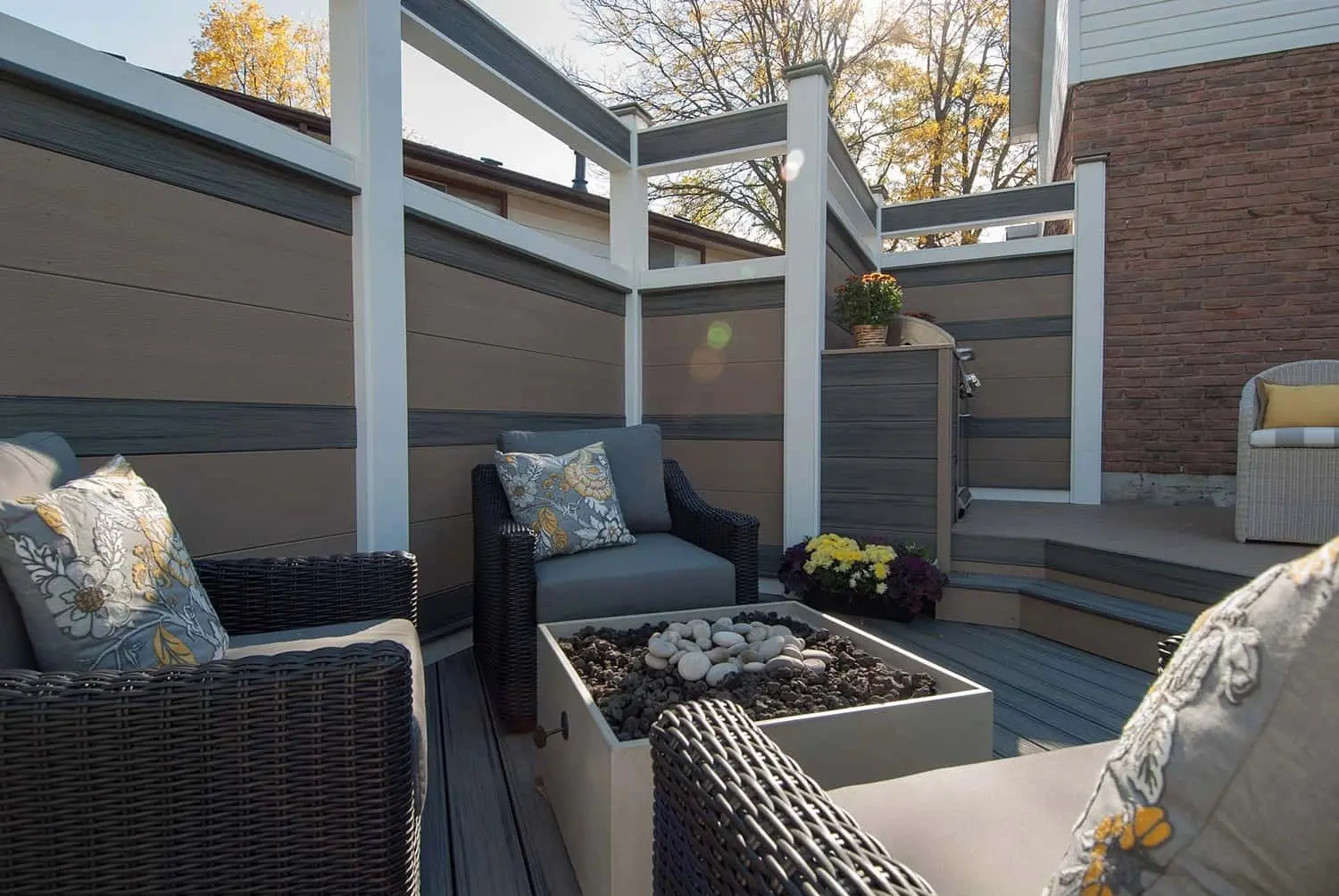
Propane gives you an instant flame and real but very local heat: a fire bowl or fire table warms the seating circle around it, not the patio. Before you install one, three things decide everything — the gas supply, the cylinder rules, and whether the appliance is certified.
Does a propane outdoor fireplace actually heat?
Yes, but not the way a patio heater does. An open fire bowl throws heat in every direction at once, and most of it goes up. What reaches you is the fraction travelling horizontally toward the people seated around it: convincing at a metre, close to nothing at three. A fire table is first and foremost a focal point, and it is worth being honest about that. If the goal is to hold a whole terrace at a comfortable temperature, that is a heating problem, not a flame problem.
BTU/h is not a measure of comfort
The BTU/h figure a manufacturer publishes is an input rating: the energy the burner consumes, not the energy that lands on you. Two appliances with the same BTU/h can feel completely different depending on bowl geometry, flame height and wind exposure. Ask for the number — but the propane number, not the natural gas one. Different orifice, different spec sheet.
Wood, propane or natural gas: which one?
The useful comparison is not purchase price. It is what each option obliges you to live with afterward.
| Option | Heat you feel | Ambiance | Main constraint |
|---|---|---|---|
| Wood fire pit | Strong, uneven | Flame, smell, crackle | Smoke and ash; open-air fires banned on the island of Montréal |
| Propane fire bowl or fire table | Moderate, very local | Adjustable flame, instant lighting | A cylinder to feed and swap |
| Natural gas fire feature | Same as propane | Same as propane | Buried line: excavation, cost, fixed position |
| Infrared heater | Directional, efficient | No flame | Power or gas at the mounting point |
Which is why so many projects end up with both: the flame as the centre of gravity, dedicated appliances for the heat. We cover that trade-off more broadly in our guide to outdoor fireplaces and patio heaters.
Cylinder, tank or a natural gas line?
This is the heaviest decision, because it fixes where the appliance lives for good.
| Supply | Installation | Permanence | Watch for |
|---|---|---|---|
| Built-in 20 lb cylinder | None: it sits in the base | None — the unit stays movable | Enclosure ventilation, run time |
| Outdoor or buried propane tank | Propane supplier, with piping | High | Tank siting, clearances, delivery truck access |
| Natural gas line | Excavation, piping, tie-in at the meter | Permanent | Cost, conversion to the right gas, appliance locked in place |
The cylinder keeps the mistake reversible; natural gas eliminates the refill chore; a tank makes sense mainly when several outdoor appliances share one source. The moment gas runs through fixed piping you are inside CSA B149.1, the Natural Gas and Propane Installation Code recognised by Québec's Régie du bâtiment. That is not a do-it-yourself job.
The cylinder rules almost everyone gets wrong
Where a 20 lb cylinder may sit
Outdoors. The Canadian Propane Association says to store cylinders outdoors whenever possible, away from heat and ignition sources, upright, off the ground on a non-combustible base, with the outlet disconnected and capped. Québec's Régie du bâtiment puts it even more bluntly in its guidance to refuelling centres: always store propane cylinders outdoors and not inside an enclosure such as a building, shed or garage.
Never below grade either. The CCOHS notes that propane "can accumulate in hazardous amounts in low-lying areas especially inside confined spaces" — a window well, a basement stairwell, a sunken patio pit. And if the appliance hides its cylinder inside a closed base, that enclosure has to be ventilated, low down, because that is where the gas settles. The required opening is written into the certified installation instructions; you follow them to the letter instead of improvising a vent. One last CPA rule, systematically forgotten: never store a spare cylinder under or near the barbecue.
Filling, requalification, transport
Filling must be done by personnel trained for that purpose, and a "single-trip" cylinder cannot be refilled at all. More importantly, a refillable cylinder must be replaced, or inspected and requalified by a Transport Canada approved requalifier, every 10 years — and it is against the law to fill an expired or damaged cylinder. Check the date stamped on the collar before you drive to the counter.
Transport: upright, valve on top, windows open, or the trunk lid blocked open. Never leave a cylinder in a parked vehicle with the windows up. Propane is odourless on its own; the ethyl mercaptan added to it is what warns you, and it warns nobody inside a car you have just walked away from.
Which ignition survives a Québec winter?
Three families: match or piezo lighting, manual lighting with a flame supervision device, and electronic ignition. The smarter the system, the more exposed components it carries.
What we see come back, in order: a fouled or damp ignition electrode; the flame supervision device that no longer sees the flame and shuts the gas off as designed; and the battery pack in an electronic module losing voltage in the cold. None of these failures is dramatic, but they all happen on the same evening — the first cool night of the fall. And flame supervision is not a gadget. It is what closes the gas when wind blows the flame out. On an exposed appliance, it is the feature that matters most.
Lava rock or fire glass: which one pops?
The media is functional, not just decorative: it spreads the flame and hides the burner. The problem is water. Lava rock is porous. It soaks up rain and snowmelt, and if you light a burner at full output on saturated stone, that water flashes to steam inside the stone — anywhere from a sharp crack to a projected fragment. Fire glass is not porous and does not hold water the same way, but the pan under the glass certainly does if its drain is plugged with leaves.
Hence two habits: a cover in the off-season, and a drain checked in spring. And nothing but the media supplied or specified by the manufacturer — no river stones, no ordinary gravel.
Clearances, wind and pergolas: where can it go?
Clearances come from the appliance
There is no universal number. Distances to combustibles — wall, siding, railing, furniture, planting — are the ones on the appliance's certified installation sheet, and that document governs, not a rule of thumb. The unit was tested at those exact clearances; reducing them voids the reasoning behind them.
Wind changes how the burner behaves
A gust does not just lean the flame over: it can blow it out and trip the safety. On rooftops and open terraces around Greater Montréal that is the number one source of frustration. A glass wind guard, an orientation that borrows an existing wall, or simply moving the bowl off the prevailing wind axis solves most cases.
Under a cover: the carbon monoxide answer
The answer is clean: an appliance certified for outdoor use stays an outdoor appliance. Health Canada notes that carbon monoxide is produced whenever you burn a fuel, propane included, and that "using these devices indoors and in other unventilated or poorly ventilated areas can expose you and others to dangerous levels of carbon monoxide." CO acts before you notice it is there.
In practice: a pergola open on all four sides is not an enclosed space, but headroom and overhead clearances are still dictated by the manufacturer's sheet. A pergola closed in with screens, a sunroom, a tent, a carport — the answer is no, and it stays no for as long as the structure is closed.
What does the City of Montréal allow?
Here the by-law works in favour of gas. The Service de sécurité incendie de Montréal states that outdoor fires are banned on the island of Montréal except in certain exceptional circumstances, because of the smoke — and that domestic use of an appliance approved for the purpose, such as a barbecue, a patio heater or a similar appliance, is not subject to a permit.
So the ban targets open wood fires, across every borough; the approved appliance passes without a permit. The operative word is approved: certification is what separates a permitted appliance from a prohibited fire. Boroughs and linked cities can add their own requirements, so confirm with yours before you order.
How do you winterise it?
Three steps, in October. Close the cylinder valve, disconnect and cap it, and store it outdoors, upright — not in the shed. Empty the bowl and check the drain. Cover the appliance with something that does not trap moisture against the concrete and the burner: high-performance concrete bowls take frost well, it is the trapped water that damages them.
The one thing to check before you buy
Certification. The RBQ is explicit: every gas appliance and every piece of gas equipment sold in Québec must be certified by a body it recognises. Thirteen bodies qualify, including CSA, ULC, cUL, Intertek, NSF and IAPMO. For a non-Canadian certifier, look for the small "c" or "ca" at the 8 o'clock position on the seal, or the maple leaf.
For outdoor gas fire features specifically, the applicable standard is ANSI Z21.97 / CSA 2.41. What it verifies is not cosmetic: safe ignition and shut-off, gas tightness, combustion quality and emissions control — so carbon monoxide — electrical safety of the ignition module, and how materials hold up under heat. Confirm the certification covers the complete appliance: a certified burner dropped into an untested bowl is not a certified appliance.
From the field
The client's question is almost never the right one. We get asked "how many BTU?" when the real variable is the distance between the seats and the flame — pulling the circle in changes comfort more than a bigger burner does, and it costs nothing. We place the bowl, then the seats, then we talk about the appliance.
We regularly turn down hidden-cylinder requests. A sealed, handsome base with no low vent is the kind of detail that works on a drawing and not in reality. If the appliance has no ventilated cylinder compartment designed into it, the cylinder goes somewhere else, outside the cabinet, even at a cost to the look. That one is not negotiable.
The first October call is always the same: "it won't light." Nine times out of ten it is the module battery, a fouled electrode, or water in lava rock left uncovered all September. A cover and a set of batteries settle the season; we leave both with the client at commissioning.
Common questions
Can a propane fire bowl replace a patio heater?
No, and it is not the same job. The bowl radiates in every direction, including up, and only warms the immediate seating circle. A heater projects its output toward a defined zone. To genuinely extend the season across a whole terrace you need dedicated heating; the fire feature gives you the gathering point instead.
Can you use a fire table under a pergola?
Under a pergola open on all four sides, yes, respecting the headroom and overhead clearances the manufacturer specifies. As soon as the structure closes in — screens down, canvas, sunroom, tent — the answer is no: burning propane in a poorly ventilated space exposes you to dangerous carbon monoxide levels, and CO acts before you perceive it.
Can a propane fire feature be converted to natural gas?
Sometimes, with the manufacturer's conversion kit and by a qualified person — never by swapping the hose. The two gases do not share a pressure or an orifice size. An improvised conversion produces a yellow flame, soot and carbon monoxide, and it voids the appliance's certification. If no kit exists for that model, the answer is no.
Can the cylinder spend the winter in the garage?
No. The guidance is consistent: outdoors, upright, on a non-combustible base, never inside an enclosure such as a building, shed or garage, and never below grade, because propane accumulates in low-lying areas and confined spaces. Cold does not damage the cylinder; being shut in is the problem.
What it comes down to
Decide first what you are buying: ambiance or heat. If it is ambiance, a propane fire bowl or fire table is an excellent choice — reversible, no construction, and legal where a wood fire is not. If it is heat, you need dedicated heating, and the flame becomes a complement.
Then three checks: the certification seal on the complete appliance, the installation sheet that sets your clearances, and a clear plan for the cylinder. We design these zones in our past projects with concrete fire features by Solus Decor and outdoor heaters from Heatsail or Bromic; infrared heating is covered separately, and our sister brand handles indoor fireplaces. To validate a configuration before you buy, get in touch.