04 — Articles
Outdoor Saunas in Quebec: What to Sort Out Before You Buy One
An outdoor sauna in Quebec earns its keep in winter, not summer — it is the one room you actually want at −20 °C. But three things decide the project before the cabin does: your municipality's accessory-building rules, the dedicated circuit an 8 kW stove needs, and how often you will realistically use it.
Why put a sauna outside instead of in the basement?
Because of the contrast. Stepping out of 90 °C heat into a January night is the whole point of the Nordic cycle, and no bathroom reproduces it. Three practical reasons back that up: no humidity load dumped into the house, no living area given up, and a structure that becomes part of the landscape design instead of a converted closet.
The honest counter-argument
An outdoor sauna needs a slab or a stable base, a dedicated electrical feed, setbacks that satisfy your zoning by-law, and snow clearing all winter. If you do not expect to use it more than once a week, a compact indoor unit will cost less to install and less to run. Frequency of use is what decides everything here — and that turns out to be true of the health data too.
What does the research actually say about sauna benefits?
The best evidence comes out of Finland. A study published in JAMA Internal Medicine in 2015 followed 2,315 middle-aged men for a median of 20.7 years. Compared with men who used a sauna once a week, those who used one four to seven times a week showed a 40 % lower risk of all-cause mortality and a 63 % lower risk of sudden cardiac death.
The numbers, and their limits
| Frequency | Sudden cardiac death | Cardiovascular mortality | All-cause mortality |
|---|---|---|---|
| 2 to 3 sessions / week | — | −27 % | −24 % |
| 4 to 7 sessions / week | −63 % | −50 % | −40 % |
Two caveats matter here, and they rarely make it into the sales pitch. First, that cohort was entirely male. Second, it was an observational study: it establishes an association, not cause and effect. People who use a sauna four times a week may simply be the people who were healthier to begin with.
A second Finnish cohort, published in BMC Medicine in 2018, included 1,688 people, 867 of them women, followed for a median of 15 years. The findings point the same way: four to seven sessions a week are associated with a marked reduction in cardiovascular mortality, and the authors note that the risk falls in a roughly linear fashion with frequency, with no apparent threshold.
What that changes for your project
None of this is a medical promise, and we will not sell it as one. What it does is reframe the question. A sauna used twice a month is a piece of leisure equipment. A sauna used four times a week is a habit, and habits are built on convenience. It is your expected frequency — not the size of your yard — that should set how much you invest in the thing.
What temperature, and for how long?
A traditional Finnish sauna runs between 80 and 100 °C at 10 to 20 % relative humidity, for sessions of 5 to 20 minutes. Those are the figures that recur in the peer-reviewed literature, not in brochures. An infrared cabin is a different appliance and runs far cooler, in the 45 to 60 °C range, with a different physiological effect.
Duration counts as much as frequency
In the 2015 cohort, sessions longer than 19 minutes were associated with a greater risk reduction than sessions under 11 minutes. Put plainly: a real session beats a quick appearance. That is also a design criterion. A cabin that is cramped, badly ventilated or awkward to sit in does not invite anyone to stay in it for twenty minutes, and it will quietly stop getting used.
Who should stay out of the sauna?
The clinical sources are unambiguous. Sauna use is not advised for people with unstable angina, a recent myocardial infarction, severe aortic stenosis, uncontrolled hypertension or decompensated heart failure. It is, on the other hand, generally well tolerated by healthy people and by those whose cardiac disease is stable and well managed.
Two specific warnings
- Alcohol. Combining a sauna with alcohol intoxication raises the risk of dehydration, hypotension, hemoconcentration and cardiac arrhythmia. This is not a politeness clause in a manual: it is the leading documented cause of sauna accidents.
- Cold plunge. Cold-water immersion after a sauna has been associated with arrhythmias in people with a cardiovascular history. If you are planning a hot-cold cycle, clear it with your physician before you build the plunge tub into the design.
If you are pregnant, managing a chronic condition, or taking medication that affects blood pressure, the right move is to check with a health professional rather than rely on a buying guide — this one included.
Barrel, cube or cabin: which format?
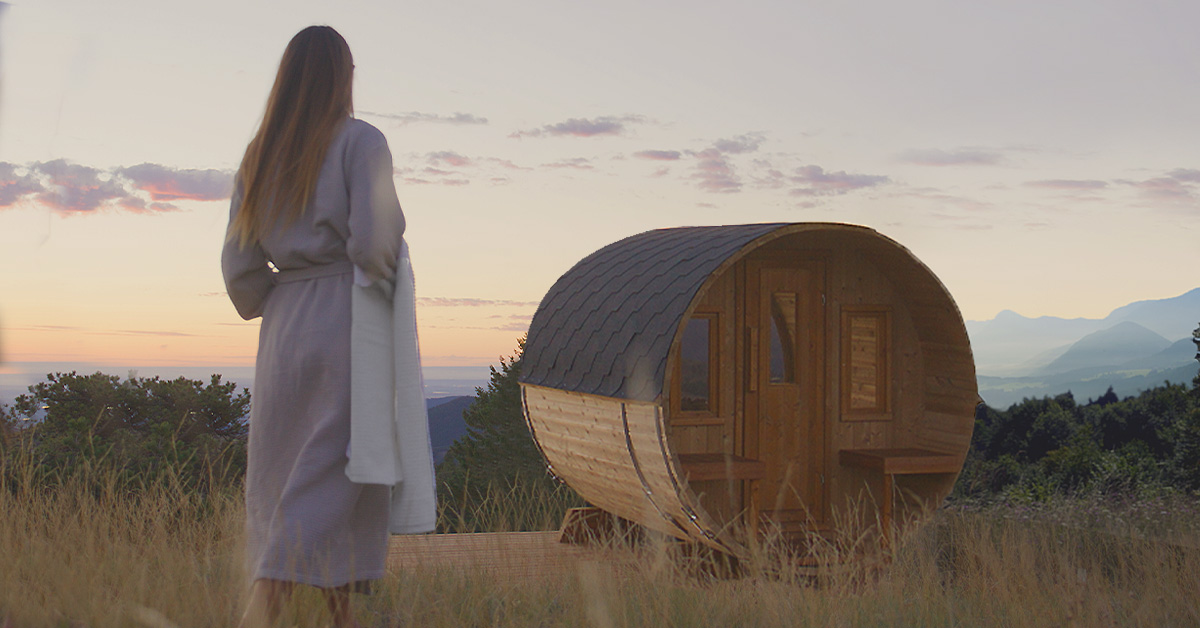
A barrel heats fast and costs less, because the volume is small and the round section leaves fewer cold pockets. A cube or a cabin gives you real headroom, a proper glazed door and sometimes a change room — which changes the experience completely once you are using it in February. Our partner Northern Saunas builds formats from two up to six people.
What to check on the spec sheet
- Species of wood. Serious models use thermally modified spruce (Thermowood) for the shell and alder for the benches. Alder does not burn skin on contact, which is not a detail once the room is at 90 °C.
- Insulation. Some models publish a PIR insulation spec; others publish nothing at all. In our climate that is the difference between a 40-minute heat-up and a 75-minute one.
- Weight. A four- to six-person cabin can exceed 800 kg empty. The base has to be sized for it, and so does the access route across the property.
- Warranty. It varies by model and is not always published. Ask for it in writing before you order, not after delivery.
Electric heater or wood-burning stove?
Electric for simplicity, wood for the experience. An electric heater can be put on a timer, heats unattended and needs no flue. A wood stove produces a heat no element reproduces, but it brings a chimney, a supply of dry wood, and a regulatory question you want answered before you place the order rather than after.
Electric: the circuit decides
Common electric heaters run from 4.5 to 8 kW depending on the volume of the room. At 240 V, a 6 kW unit draws 25 A and an 8 kW unit draws 33.3 A. The Quebec Construction Code requires that a heating appliance drawing more than 30 A be supplied by a branch circuit serving no other appliance. Translation: an 8 kW heater needs a dedicated circuit, full stop.
And that circuit is not a weekend project. In Quebec, only master electricians may perform electrical work, including in your own home. The CMEQ points out that fines run from $5,000 to more than $200,000. This line item belongs in the budget from day one, not as a surprise at installation.
Wood: a grey area in Montreal
Montreal's solid-fuel appliance by-law requires that any such appliance emit less than 2.5 g of particulate matter per hour and be EPA certified or compliant with CSA B415.1-10. The published text does not spell out whether it also covers appliances located in an accessory building such as a sauna. We are not going to rule on that in the City's place: call your borough before ordering a wood-burning stove, and get the answer confirmed in writing.
Do you need a permit for an outdoor sauna?
Usually yes, and the answer depends on your municipality. Outdoor saunas are almost never named as such in a zoning by-law. They are treated as accessory buildings, the same category as a garden shed. The thresholds, maximum heights and setbacks vary from one city to the next — and in Montreal, from one borough to the next.
Three examples to set the order of magnitude
| Municipality | Permit threshold | Published constraints |
|---|---|---|
| Montreal — Ville-Marie borough | No permit under 15 m² | Max height 4 m; at least 1.5 m from the walls of the main building (except the rear wall); prohibited in the front yard |
| Laval | Permit required from 18 m² of ground footprint | Under 18 m², no permit, but rules still apply |
| Longueuil | Permit required in every case | Max 20 m² for single-family; max height 4.5 m; 0.5 m from a lot line; 1.5 m from the main building; one shed per property |
These figures illustrate the spread between municipalities; they do not replace a check with yours. The City of Montreal says so itself: contact your borough before you buy.
What does one session cost?
Under a dollar. An 8 kW heater running for one hour consumes 8 kWh. Under Hydro-Québec's Tarif D in effect since April 1, 2026, that kilowatt-hour costs 11.142 ¢ at the second tier — which is where just about every Greater Montreal household sits in winter. A session therefore works out to roughly $0.89, heat-up included.
At a steady four sessions a week, that is about $15 a month. Operating cost is not the issue with these projects. The initial installation is, and within it the electrical circuit is the line that moves the budget.
From the field: the three decisions that always come up
Where to put it. The instinct is to place it at the back of the yard, away from the house. In January, nobody crosses fifteen metres of snow in a bathrobe. The right spot is within ten metres of a door, on a path you can clear with one pass of a shovel.
Where the wire runs. On the projects we coordinate, the dedicated circuit is almost always the underestimated item — especially when the panel is already full and a new one has to go in. We have the master electrician confirm panel capacity before we confirm the heater model, never the other way around.
Which way you come out. The sauna door should open onto a zone sheltered from the prevailing wind. That single detail decides whether the sauna gets used from November to March or only from May to September. Our project managers lay out that sequence with the rest of the landscape plan.
Common questions
How long does an outdoor sauna take to heat in winter?
Count on 40 to 75 minutes depending on insulation, volume and heater output. A well-insulated cabin with a heater correctly sized for its volume heats noticeably faster, and in a Quebec winter that gap widens. This is where PIR insulation pays for itself — not in the spec sheet, but in whether you bother firing it up on a Tuesday night.
Can an outdoor sauna stay outside year-round?
Yes, that is what it is built for. Models designed for outdoor use are made of thermally modified wood with a weathertight roof. What damages them is not cold but standing water. Make sure the base drains properly and that the roof sheds well clear of the walls, and check the drainage again after the first spring thaw.
What heater output for what volume?
Manufacturers publish a volume range per model — for example 5 to 9 m³ for a 6 kW unit and 7 to 12 m³ for an 8 kW unit. An undersized heater will never reach temperature; an oversized one cooks the air without ever heating the benches. The calculation is based on the actual volume of the room, not on the number of seats advertised.
Do you need a concrete slab?
Not necessarily. Compacted crushed stone, concrete deck blocks or a structure on helical piles all do the job, provided the result is level and drains. The critical factor is weight: some cabins exceed 800 kg before anyone sits down in them. Size the base for the loaded cabin, and confirm the delivery route can take it.
Can you install a sauna on a rooftop terrace or a condo balcony?
Technically sometimes, legally rarely. You need load capacity confirmed by an engineer, approval from the condo board, and a dedicated electrical circuit run by a master electrician. Get all three in writing before you buy anything — a deposit on a cabin the syndicate later refuses is an expensive way to learn this. Ask us before you commit.
A sauna is planned before it is purchased
The order that works: check your municipality's by-law, have the electrical panel capacity assessed, choose the location based on winter rather than summer, and only then choose the model. Reverse that order and you end up redesigning the project around a cabin you have already paid for. Our project managers walk through those first three steps with you.
The full range is laid out in our saunas section, including the Northern Saunas models we carry. If the project takes in the whole yard, look at how a bioclimatic pergola extends the usable season on the same terrace. For heating inside the house, our sister brand Noréa Foyers takes over. Write to us with the dimensions of your yard and we will start from the by-law. And if the sauna is part of a full backyard rework, start with how the zones on a terrace should sit relative to one another.